


When you hear about the “5 personality trait test,” you’re encountering one of the most widely accepted theory frameworks in personality psychology. This assessment—also known as the Big Five personality test or the Five Factor Model (often referred to as the OCEAN model)—breaks down human personality into five broad dimensions: openness to experience, conscientiousness, extraversion, agreeableness, and neuroticism (sometimes reframed as emotional stability).

 Unlike casual internet quizzes that tell you which fictional character you resemble, this personality test is scientifically grounded in decades of research from the late 20th century through 2025. It helps people understand how they typically think, feel, and behave across work, relationships, and everyday situations. The test doesn’t put you in a box or assign you a “type.” Instead, it shows where you fall on a spectrum for each of the five traits, giving you a nuanced picture of your individual personality. Each of the Big Five personality traits represents a continuum, meaning individuals can fall anywhere on the continuum for each trait.
This article will give you a quick overview first—so you get an immediate answer about what this test measures—then go deeper into how the assessment works, what each trait means, and how you can actually use your results. Here’s why someone might want to take this personality assessment:
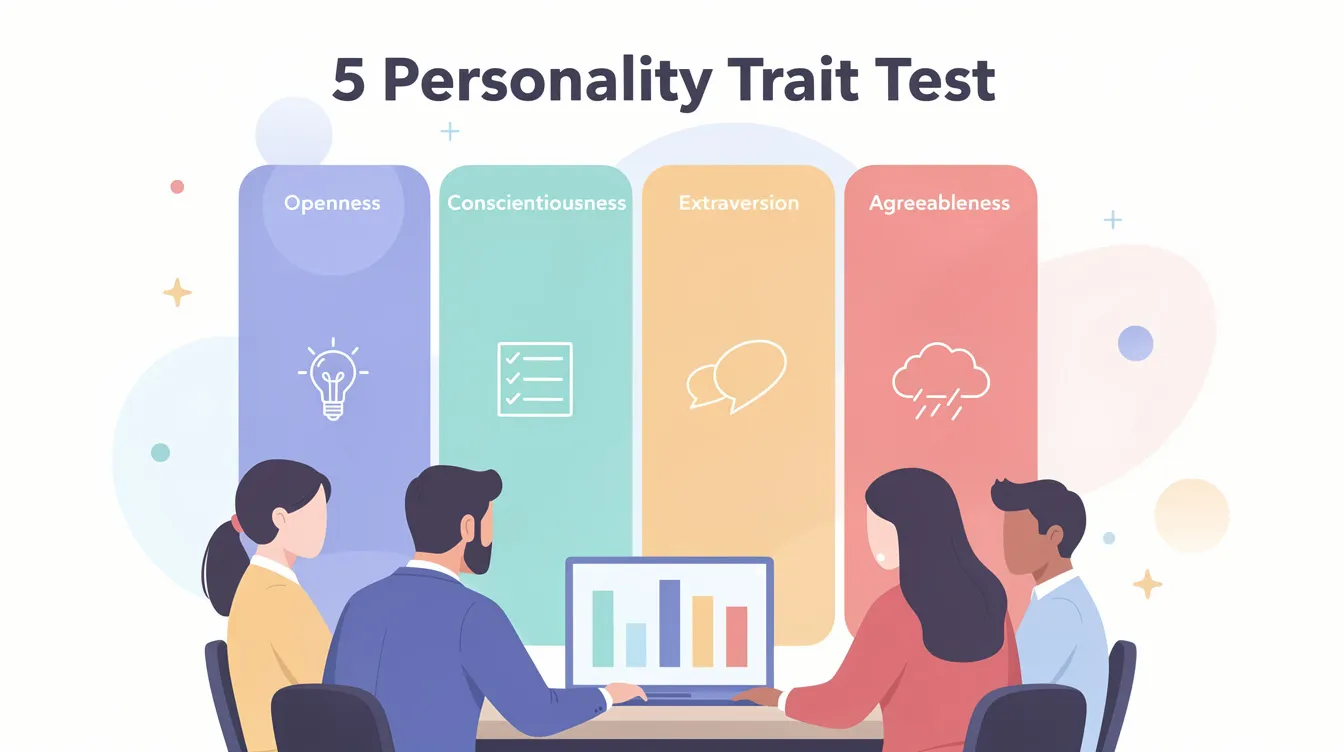 The big five personality traits capture the major traits that explain most variance in human behavior and personality differences. Here’s what each dimension represents:
Openness to experience reflects intellectual curiosity, imagination, and preference for novelty versus routine. Conscientiousness describes self-discipline, organization, and goal-directed persistence. Extraversion measures sociability, energy from interaction, and comfort with attention. Agreeableness captures cooperation, empathy, and concern for others feelings. Neuroticism (the inverse of emotional stability) indicates tendency to experience negative emotions like anxiety, sadness, and irritability.
Each particular trait operates on a continuum—you’re not simply “an extravert” or “an introvert.” You might score high, average, or low, and your position tells you where you fall relative to the general population. A high score in one area isn’t inherently better than a low score; each end of the spectrum brings different strengths and trade-offs.
Typical online Big Five tests use 20–120 items, asking how much you agree with statements on a 1–5 or 1–7 scale. Examples include “I make friends easily” or “I seldom feel blue.” Most tests estimate where you fall compared to normative samples rather than providing a clinical diagnosis or labeling you with a personality disorder.
For accurate results, you should answer based on your usual, everyday behavior over the past few years—not how you wish you were or how you acted during one exceptional week. When you complete a personality test, you typically receive:
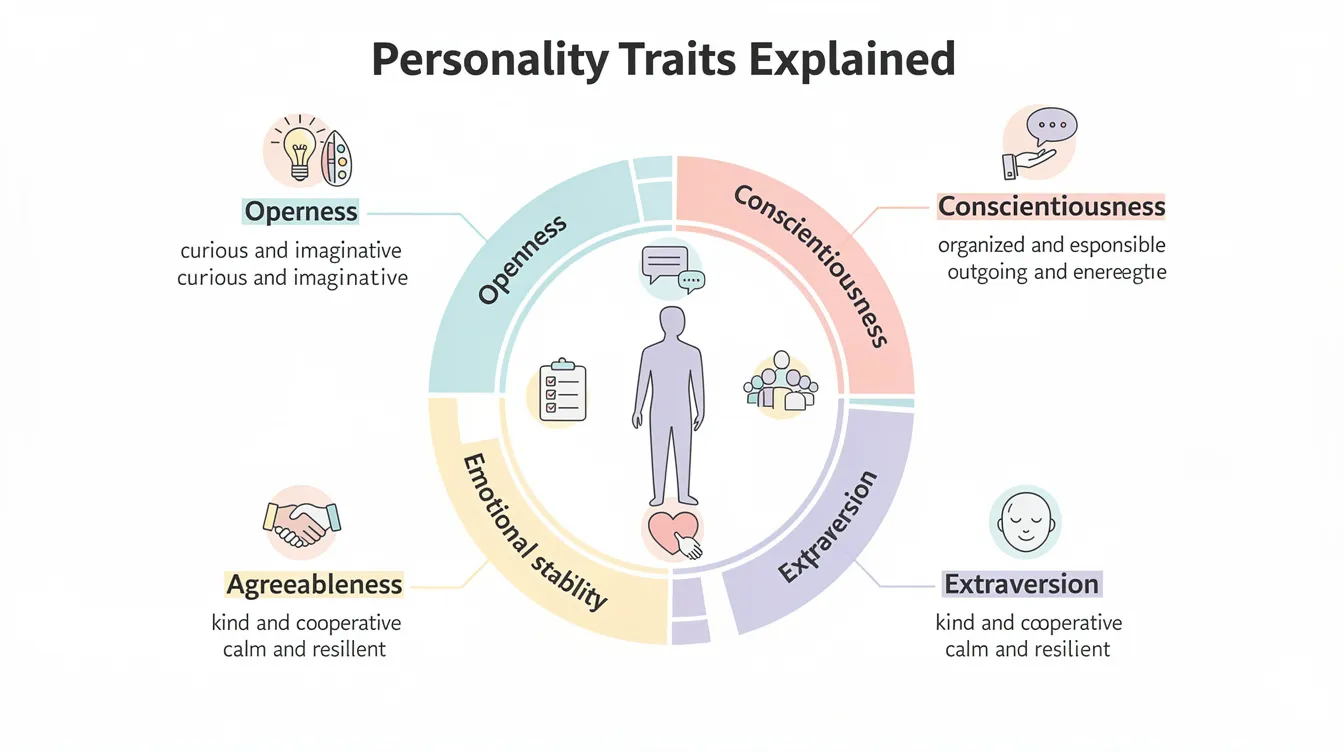 Modern models often break each trait into narrower facets. Extraversion, for example, includes sub-dimensions like sociability, assertiveness, and excitement-seeking. Conscientiousness encompasses competence, order, dutifulness, achievement striving, self-discipline, and deliberation. However, this article focuses on the broad trait level, which provides the clearest picture for most people exploring their results.
In a typical test report, each trait appears with a percentile score (showing where you rank compared to others), a written description interpreting your score, and practical implications for work, relationships, or personal development. The trait dimensions work together to form your unique profile—someone high in openness and low in neuroticism will approach life differently than someone low in openness and high in neuroticism, even if they share similar conscientiousness scores. It’s important to note that personality traits in the Five-Factor Model are independent of each other; while personality traits relate to various behaviors, preferences, and outcomes, each trait is statistically separate from the others.
The following sections cover each trait in turn, explaining what it measures and describing characteristics associated with low, medium, and high scores.


Unlike casual internet quizzes that tell you which fictional character you resemble, this personality test is scientifically grounded in decades of research from the late 20th century through 2025. It helps people understand how they typically think, feel, and behave across work, relationships, and everyday situations. The test doesn’t put you in a box or assign you a “type.” Instead, it shows where you fall on a spectrum for each of the five traits, giving you a nuanced picture of your individual personality. Each of the Big Five personality traits represents a continuum, meaning individuals can fall anywhere on the continuum for each trait.
This article will give you a quick overview first—so you get an immediate answer about what this test measures—then go deeper into how the assessment works, what each trait means, and how you can actually use your results. Here’s why someone might want to take this personality assessment:
- Gain insight into natural strengths and potential blind spots
- Make more informed career and educational decisions
- Improve communication in relationships and teams
- Understand patterns in stress responses and emotional reactions
- Create environments and habits that fit your personality differences
Introduction to Personality Traits
Understanding personality traits is a cornerstone of exploring human behavior and what makes each of us unique. Personality traits are the enduring patterns of thoughts, feelings, and behaviors that distinguish individuals from one another. Among the many models developed to describe these differences, the Big Five personality traits—also known as the Five Factor Model—stand out as the most widely accepted theory in personality psychology. The Big Five personality traits break down human personality into five broad dimensions: openness to experience, conscientiousness, extraversion, agreeableness, and neuroticism. Each of these trait dimensions represents a spectrum, allowing for a nuanced understanding of individual differences rather than rigid categories. This model is grounded in factor analysis, a statistical approach that distills a vast array of human behaviors and descriptors into a handful of core factors, making it a reliable psychological model for both research and practical applications.Quick Overview: What the 5 Personality Trait Test Measures
The big five personality traits capture the major traits that explain most variance in human behavior and personality differences. Here’s what each dimension represents:
Openness to experience reflects intellectual curiosity, imagination, and preference for novelty versus routine. Conscientiousness describes self-discipline, organization, and goal-directed persistence. Extraversion measures sociability, energy from interaction, and comfort with attention. Agreeableness captures cooperation, empathy, and concern for others feelings. Neuroticism (the inverse of emotional stability) indicates tendency to experience negative emotions like anxiety, sadness, and irritability.
Each particular trait operates on a continuum—you’re not simply “an extravert” or “an introvert.” You might score high, average, or low, and your position tells you where you fall relative to the general population. A high score in one area isn’t inherently better than a low score; each end of the spectrum brings different strengths and trade-offs.
Typical online Big Five tests use 20–120 items, asking how much you agree with statements on a 1–5 or 1–7 scale. Examples include “I make friends easily” or “I seldom feel blue.” Most tests estimate where you fall compared to normative samples rather than providing a clinical diagnosis or labeling you with a personality disorder.
For accurate results, you should answer based on your usual, everyday behavior over the past few years—not how you wish you were or how you acted during one exceptional week. When you complete a personality test, you typically receive:
- Trait scores showing your relative standing on each dimension
- Brief descriptions explaining what your scores suggest
- Sometimes graphs or visual comparisons to population averages
- Occasionally, breakdowns of narrower facets within each trait
How the Big Five Personality Test Works
Modern Big Five tests follow a consistent structure that has been refined over decades. The test consists of Likert-scale questions—statements where you indicate agreement from “strongly disagree” to “strongly agree” on scales of 1–5 or 1–7. Quick versions contain 30–60 items, while research-grade inventories can include up to 240 items for more detailed facet analysis. Statements cover your thoughts, feelings, and behaviors across different contexts: how you handle work deadlines, what energizes you socially, how you respond to criticism, and whether you enjoy abstract ideas. Some items are reverse-scored to reduce response bias. For instance, “I have difficulty understanding abstract ideas” would be scored inversely for the openness dimension. Several well-known scientific instruments form the foundation of modern testing. The NEO Personality Inventory (NEO-PI-3, updated in 2010) remains a gold-standard 240-item tool used in research and clinical psychology. The Big Five Inventory (BFI-2, released in 2015) offers a 30-item version suitable for faster administration. Many free online assessments draw from the International Personality Item Pool (IPIP), which provides validated scales ranging from 20 to 120 items. Scoring works by summing your raw responses on items related to each trait, adjusting for reverse-coded items, and comparing your totals to norms developed from large samples collected between the 1980s and 2020s across various countries. Reliable inventories include consistency checks to flag random or contradictory responding. Key elements of a valid Big Five assessment:- Number of items: 30–60 for brief versions; 120–240 for comprehensive research tools
- Response scale: Typically 5 or 7 points from strongly disagree to strongly agree
- Time to complete: 5–15 minutes for standard versions; longer for detailed facet assessments
- Score output: Percentile rankings, descriptive summaries, and sometimes facet breakdowns
The Five Core Personality Traits Explained
Each of the five traits in this reliable psychological model has advantages and trade-offs at both ends of the spectrum. No score is inherently “good” or “bad”—what matters is understanding your tendencies and how they play out in different situations.
Modern models often break each trait into narrower facets. Extraversion, for example, includes sub-dimensions like sociability, assertiveness, and excitement-seeking. Conscientiousness encompasses competence, order, dutifulness, achievement striving, self-discipline, and deliberation. However, this article focuses on the broad trait level, which provides the clearest picture for most people exploring their results.
In a typical test report, each trait appears with a percentile score (showing where you rank compared to others), a written description interpreting your score, and practical implications for work, relationships, or personal development. The trait dimensions work together to form your unique profile—someone high in openness and low in neuroticism will approach life differently than someone low in openness and high in neuroticism, even if they share similar conscientiousness scores. It’s important to note that personality traits in the Five-Factor Model are independent of each other; while personality traits relate to various behaviors, preferences, and outcomes, each trait is statistically separate from the others.
The following sections cover each trait in turn, explaining what it measures and describing characteristics associated with low, medium, and high scores.

Openness to Experience
Openness to experience measures your curiosity about ideas, art, emotions, and new experiences. People high in this trait have a vivid imagination and tend to question routines, embrace creativity, and seek out novel situations. Those who score lower prefer clear instructions, proven methods, and practical, concrete information over theoretical speculation. Characteristics of high openness:- Enjoys abstract discussions, philosophy, and exploring new ideas
- Intellectually curious, seeking out new knowledge and experiences
- Drawn to art, music, literature, and creative expression
- Eager to try unfamiliar foods, visit new cultures, and break from routine
- Interested in long-term learning—taking online courses, reading widely, attending workshops
- Comfortable with ambiguity and unconventional viewpoints
- Possesses a rich vocabulary and appreciates language nuances
- Prefers tradition, structure, and familiar environments
- Values practical skills over theoretical knowledge
- May find difficulty understanding abstract ideas or see them as impractical
- Thrives in roles with clear procedures and well-defined tasks
- Tends toward conventional views and established routines
Conscientiousness
Conscientiousness describes your level of self-discipline, organization, reliability, and persistence toward goals. This trait captures how you manage impulses, plan for the future, and follow through on commitments. It’s strongly linked to impulse control and achievement striving. Characteristics of high conscientiousness:- Keeps calendars, to-do lists, and detailed plans
- Meets deadlines consistently and double-checks work for errors
- Follows through on promises and takes responsibilities seriously
- Approaches tasks methodically with attention to detail
- Everything has a proper place and systems exist for everything
- Rarely procrastinates on important work
- More spontaneous and flexible in approach
- May procrastinate, lose track of details, or jump between tasks
- Prefers adapting in the moment over long-term planning
- Can struggle with routine maintenance tasks
- Gets easily distracted by new interests or opportunities
Extraversion
Extraversion reflects a person’s tendency toward sociability, talkativeness, assertiveness, and energy derived from social interaction. This trait captures how you engage with the external world and where you draw attention and energy. Characteristics of high extraversion:- Feels energized by group activities, parties, and networking events
- Initiates conversations easily and enjoys meeting new people
- Comfortable being the center of attention
- Tends toward optimism and positive emotions in social contexts
- Speaks first and thinks later in discussions
- May grow restless when alone for extended periods
- Prefers one-on-one conversations over large gatherings
- Needs quiet time alone to recharge after social demands
- May spend time reflecting before contributing to discussions
- Feels drained by extended socializing
- Often prefers written communication to spontaneous verbal exchange
- Works effectively in solo, deep-focus environments
Agreeableness
Agreeableness evaluates your orientation toward cooperation, empathy, trust, and concern for others’ needs. This trait captures how you relate to people—whether you prioritize harmony or competition, connection or independence. Characteristics of high agreeableness:- Considerate, helpful, and quick to offer support
- Conflict-averse and willing to compromise
- Trusting of others’ intentions
- Has a soft heart and can feel others emotions easily
- Forgiving and slow to hold grudges
- Sensitive to criticism and rejection
- More skeptical of others’ motives
- Competitive and focused on personal goals
- Blunt and direct, even when it might hurt feelings
- May insult people unintentionally through excessive candor
- Comfortable with confrontation and debate
- Prioritizes accuracy over social harmony
Neuroticism (Emotional Stability)
Neuroticism describes your tendency to experience negative emotions such as anxiety, anger, sadness, and self-doubt. It captures how you perceive situations—whether as threatening or manageable—and how quickly you recover from setbacks. High emotional stability represents the opposite end of this dimension. Characteristics of high neuroticism:- Prone to frequent worry, stress, and self-doubt
- Experiences frequent mood swings and emotional reactivity
- Gets irritated easily and may dwell on problems
- Sensitive to criticism, rejection, and perceived threats
- May feel blue often or experience periods of sadness
- Struggles to recover quickly from disappointments
- Generally calm, composed, and resilient
- Slow to anger and quick to recover from setbacks
- Maintains perspective under pressure
- Less likely to feel overwhelmed by challenges
- May seldom feel blue or experience anxiety
- Takes criticism in stride without rumination
Taking a 5 Personality Trait Test: Practical Tips
Approaching a Big Five assessment thoughtfully improves the accuracy and usefulness of your results. Here’s how to get the most value from any particular test you take: Set aside adequate time. Most reliable tests take 10–15 minutes to complete. Rushing through items undermines accuracy, and interrupted sessions can shift your mindset between responses. Choose a quiet, neutral environment. Your mood and surroundings influence responses. Take the test when you’re neither unusually stressed nor exceptionally energized—aim for a typical state. Answer based on your typical behavior. Reflect on how you’ve generally acted over the past 1–3 years, not how you behaved yesterday or during an unusual period. The goal is capturing your baseline tendencies. Be honest and consistent. Rate how you actually act, not how you want to appear or think you “should” be. Tests often include consistency checks that flag contradictory patterns. Don’t overthink individual items. Your first instinct usually reflects genuine tendencies better than deliberated responses. If a statement doesn’t fit perfectly, choose the closest answer and move on. Avoid gaming the test. Trying to present an idealized version of yourself—especially for job applications—distorts results and undermines self-insight. Inconsistent answers become apparent in well-designed inventories. Don’t take multiple tests back-to-back. Fatigue changes responses, and seeing similar items repeatedly can create anchoring effects. Space assessments by at least a few days. Save your results. Many free personality tests don’t store detailed profiles long-term. Download, screenshot, or write down your scores and interpretations for future reference. Free scientifically validated Big Five tests are available at sites like Truity and OpenPsychometrics. For those wanting to deepen their understanding of personality in the context of relationships, Jeter AI’s Complete Guide to Dating in Cities 2026 offers valuable insights on how personality assessments and AI compatibility tools can enhance dating success. Additionally, learn how to find better matches on popular dating apps like Tinder, Bumble, and Hinge with Jeter AI’s guide.
Interpreting Your 5 Trait Results
Understanding what your test results mean helps you move from numbers on a screen to genuine self-insight. Here’s how to make sense of your Big Five profile: Percentile scores indicate relative standing. Scoring in the 70th percentile in extraversion means you’re more extraverted than approximately 70% of the comparison group. Scoring in the 30th percentile means you’re more introverted than most. Neither is better—they simply describe where you fall. Look at patterns across all five traits. Your unique profile emerges from the combination, not any single dimension. A person high in conscientiousness and agreeableness approaches teamwork differently than someone high in conscientiousness but low in agreeableness. Both might excel at meeting deadlines, but their interpersonal styles differ significantly. Consider these example profiles and how they might appear in practice:- High conscientiousness + high agreeableness: Reliable team players who meet deadlines and maintain positive relationships, though may struggle with giving critical feedback
- Low neuroticism + high openness: Calm explorers who pursue novel ideas without excessive worry, though may underestimate genuine risks
- High extraversion + low agreeableness: Assertive leaders who speak up readily but may dominate discussions or overlook others’ contributions
Scientific Background of the Big Five Model
The model of personality underlying the 5 personality trait test has deep roots in psychological research, making it far more robust than pop psychology alternatives. The story begins with the lexical hypothesis—the idea that fundamental personality differences become encoded in everyday language. In 1936, Allport and Odbert compiled over 18,000 English adjectives describing personality, reasoning that important distinctions would naturally develop words to describe them. Raymond Cattell applied factor analysis to this massive list in the 1940s, reducing it to 16 primary factors. However, subsequent researchers found that even fewer dimensions captured most of the variance in personality descriptions. In 1961, Tupes and Christal identified five robust factors that consistently emerged across studies. Warren Norman replicated these findings in 1963, and Lewis Goldberg popularized the lexical approach through the 1980s and 1990s. The most influential modern development came from Paul Costa and Robert McCrae, who created the NEO Personality Inventory in the 1980s, refined through multiple versions up to NEO-PI-3 in 2010. Their work embedded the five traits into comprehensive research-grade tools with facet subscales, establishing the five factor model as a dominant framework in personality psychology. By the early 2000s, cross-cultural replications had confirmed the five factor structure in languages including German, Chinese, Dutch, and several South Asian languages. While some cultural variations exist, the basic personality dimensions appear broadly stable across human populations. Key milestones in Big Five development:- 1936: Allport and Odbert compile trait-descriptive adjectives
- 1940s: Cattell reduces list to 16 factors using factor analysis
- 1961: Tupes and Christal identify five consistent factors
- 1963: Norman replicates five-factor findings
- 1980s–1990s: Costa, McCrae, and Goldberg establish modern Big Five framework
- Early 2000s: Cross-cultural replication confirms broad applicability
- 2000s–present: HEXACO model adds a sixth factor (Honesty–Humility) while retaining Big Five analogs
Applications of the 5 Personality Trait Test
As of 2024–2026, Big Five profiles find widespread use across research and practical settings, from universities to multinational organizations. Understanding human behavior through this lens has proven valuable in multiple domains. Career and workplace applications:- Matching candidates to roles (high conscientiousness in detail-heavy jobs, high extraversion in sales and public relations)
- Leadership development programs that address trait-related blind spots
- Team-building exercises that leverage complementary personality profiles
- Research shows conscientiousness as the strongest predictor of job performance across occupations (meta-analysis)
- Predicting study habits and academic success in students
- Anticipating adjustment challenges during major transitions (starting university, changing careers)
- Tailoring learning environments to individual differences in openness and conscientiousness
- Providing context for coping styles and vulnerability to stress
- Tailoring interventions (e.g., CBT approaches for high neuroticism, behavioral activation for low conscientiousness)
- Screening for emotional instability patterns that may warrant further evaluation
- Supporting treatment planning by understanding a client’s interpersonal style through agreeableness scores
- Studying gender differences in personality across populations
- Examining links between personality and political attitudes, religiosity, and values
- Analyzing how environmental factors and cultural contexts shape trait expression
- Understanding technology use patterns and communication preferences across demographic groups


