


Are you ready to discover how technology is reshaping the way we understand love and relationships? In today’s digital age, artificial intelligence is transforming everything from dating apps to relationship advice. One of the most exciting innovations is the AI compatibility calculator—a tool that uses advanced algorithms to analyze romantic compatibility and provide instant, personalized insights. Whether you’re single, in a new relationship, or looking to deepen your connection, AI-powered love tests are making it easier than ever to explore your compatibility and strengthen your bond.
AI Compatibility Calculator: How AI Is Revolutionizing Love Tests

People have taken love tests and compatibility quizzes for decades, but now AI compatibility calculators are revolutionizing the way we understand relationships. But traditional quizzes rely on simple scoring and generic questions that rarely capture the complexity of real relationships. Today, AI-powered tools analyze patterns, communication styles, and personality traits to produce deeper insights than any magazine quiz ever could.
Experience the power of instant AI compatibility testing with advanced AI love calculators that provide immediate, personalized relationship insights. These tools analyze your communication styles, personality traits, and relationship dynamics to deliver a comprehensive compatibility score in seconds. Advanced AI compatibility calculators calculate your love percentage and relationship potential by analyzing over 50 relationship factors, including communication styles and emotional needs. By entering simple details like names, birthdates, or chat samples, you receive not only a compatibility percentage but also a clear breakdown of your relationship’s strengths and potential challenges. Many calculators also allow you to enter your zodiac sign, revealing compatibility insights based on astrological signs and emphasizing the role of signs in love-related features. Many AI compatibility calculators also offer customized recommendations to help you strengthen your bond and enhance your connection, making the process both insightful and engaging.
Want to see how AI compatibility analysis actually works? You can try an AI compatibility calculator right now at https://jeter.ai/compatibility-test/.
The Jeter AI compatibility test analyzes your communication style, values, and relationship patterns to generate a comprehensive compatibility overview. Simply enter your data, and the tool processes it using advanced AI to deliver relationship insights in seconds. AI improves its predictions by learning from patterns found in verified long-term couples, making the insights more accurate and relevant.
What you get instantly:
- A compatibility score with clear breakdown that also helps you discover the ‘spark’ or chemistry between you and your partner
- Main strengths in your relationship dynamic
- Potential friction points to watch for
- Personalized recommendations based on your input
Try the Jeter AI Compatibility Test Now →
For a deeper dive into the science behind AI-powered compatibility, check out Love Test: The Science-Backed Compatibility Calculator to See If You’re Truly Compatible.
From Magazine Quizzes to AI Love Calculators: A New Era
Remember flipping through Seventeen or Cosmopolitan in the late 1990s, circling answers to discover your “love style”? Those quizzes belonged to an early class of love tests, asking fixed questions like “Do you prefer quiet nights or parties?” and summed your responses into a simple percentage. Early 2010s online love calculators introduced a new kind of compatibility test—you’d enter two names and birthdays, and an algorithm would spit out a love percentage based on numerology or zodiac signs.
These tools relied entirely on static rules. A quiz might label someone “romantic” based on five yes/no answers, missing every nuance of how that person actually behaves in relationships.

The evolution at a glance:
Each era introduced a new class or kind of love test, from magazine quizzes to online calculators and now AI-powered compatibility tools.
- 1990s–2000s: Magazine quizzes with multiple-choice answers and generic scoring (e.g., “mostly A’s = soulmate material”)
- Early 2010s: Online calculators using names, birthdays, or zodiac signs to generate fun but shallow percentages
- 2024–2025: AI compatibility calculators that analyze language, communication patterns, and personality traits from real conversations
Consider the contrast: an old “What’s your love style?” quiz might ask ten generic questions and conclude you’re a “passionate partner.” Today, there are different kinds of compatibility tests, including AI love calculators that read actual messages between partners to detect empathy patterns, conflict styles, and emotional tone—revealing insights no fixed quiz could discover.
Before you meet someone new, it’s a great idea to understand your compatibility better by taking a compatibility test before a first date, which can save time and reduce dating burnout.
What Are Love Tests and Compatibility Calculators?
An AI compatibility calculator is a tool that uses artificial intelligence to analyze romantic compatibility based on user inputs such as names, birthdates, zodiac signs, and relationship patterns. These calculators provide instant compatibility scores and personalized relationship insights by evaluating multiple relationship factors, including communication styles and emotional needs.
A love compatibility test is any tool designed to assess romantic potential between people. A relationship compatibility calculator aims to quantify that fit with scores, percentages, or categories that predict harmony or highlight potential risks.
Traditional quiz types include:
- Magazine-style love tests: 10–20 multiple-choice questions about ideals and preferences
- Name-based love calculator tests: Tools that assign numerical values to letters in two names to produce a compatibility percentage
- Zodiac-based tests: Charts comparing Sun signs (like Aries with Leo) using elemental rules and reading the stars to determine compatibility
- Personality-based tests: Structured assessments that map individuals to fixed categories
Compatibility tests, especially those based on astrology, aim to reveal the cosmic chemistry and emotional resonance between partners.
The Myers–Briggs Type Indicator (MBTI), developed from work by Katharine Cook Briggs beginning in the 1910s and formalized by her daughter Isabel Briggs Myers during the 1940s, represents an early structured approach to personality compatibility. MBTI categorizes people into 16 types based on four dichotomies, and compatibility charts often claim certain pairings (like ENFP-INFJ) work especially well.
Real-world examples: Sites like TheLoveCalculator.com from the early 2000s processed names through undisclosed math for entertainment percentages. Horoscope sites offered zodiac compatibility tests comparing fire signs and water signs using static elemental rules.
Most traditional tools share a common limitation: they rely on fixed rules and predetermined categories that can’t adapt to individual circumstances.
For couples looking to deepen their connection, exploring 100 compatibility questions for couples can be a helpful step before commitment.
The Limitations of Traditional Love Tests
Traditional compatibility tests seem harmless enough as entertainment, but they carry real limitations when people take them seriously.
Generic scoring systems ignore nuance:
- Every “A answer = 2 points” system treats complex human behavior as interchangeable
- Cultural differences in expressing affection get flattened into universal assumptions
- Two people from different backgrounds answering identically might have wildly different actual compatibility
Limited personalization:
- Everyone answers the same questions regardless of orientation, culture, or relationship stage
- A quiz designed for singles gives identical questions to couples married for 20 years
- No accommodation for diverse relationship structures or communication styles
Static nature:
- Results never improve as relationships grow or people share more data
- A quiz taken in January produces the same result in December, despite months of change
- No learning or adaptation happens over time
Absence of behavioral analysis:
- Tests rarely examine how people actually talk, argue, or support each other
- A couple might score “perfect match” on a 10-question quiz despite constant real-world conflict
- Studies show MBTI has test-retest reliability of only 50–70% over several months, with no proven link to relationship success
Imagine two extroverts scoring a “perfect match” on a compatibility quiz, only to clash constantly because one uses passive-aggressive communication the test never detected. That gap between quiz results and reality represents the core limitation of traditional love tests.
How AI Is Transforming Compatibility Testing
AI compatibility analysis works fundamentally differently from fixed quizzes. Instead of matching answers to predetermined keys, AI learns from data to identify meaningful patterns.
Pattern recognition:
- AI detects recurring themes across hundreds of answers or messages
- Phrases like “we compromise” appearing frequently signal collaborative dynamics
- Repeated patterns of criticism or withdrawal get flagged as potential friction points
Natural language analysis:
- AI analyzes open-ended text to infer emotional tone, empathy, and priorities
- How someone describes their partner reveals attitudes a multiple-choice question can’t capture
- Sentiment analysis identifies positivity ratios, frustration markers, and reassurance patterns
Personality modeling:
- AI builds probabilistic pictures of traits rather than forcing rigid labels
- Instead of “you are an ENFP,” AI might indicate “60% tendency toward anxious attachment with strong empathy markers”
- Profiles emerge from thousands of data points rather than 20 quiz questions
Behavioral prediction:
- Given patterns from similar couples, AI estimates likely pressure points
- If data shows that withdrawal-prone communication correlates with higher conflict, AI flags this risk
- Predictions are probabilities, not certainties
Jeter AI exemplifies this approach—using text-based inputs to highlight relationship strengths and potential friction, leveraging natural language processing to deliver depth unattainable through traditional methods.
Technologies Powering AI Love Tests
Today’s AI love calculators combine multiple technologies rather than relying on a single algorithm. Understanding these components helps clarify how AI powered insights actually work.
Machine learning:
- Systems trained on large datasets of relationship examples and psychological patterns
- Models learn to spot compatibility signals from anonymized therapy logs, app interactions, and relationship outcomes
- Training data helps AI distinguish healthy communication patterns from problematic ones
Behavioral data analysis:
- Response speed can indicate enthusiasm or hesitation
- Consistency across answers reveals reliability
- Thematic patterns in open-ended responses derive relationship tendencies
Personality modeling:
- AI infers traits like openness, attachment style, conflict approach, and emotional responsiveness
- Models draw from established psychological frameworks without forcing rigid categories
- Continuous refinement happens as more data becomes available
Conversation analysis:
- AI evaluates chat logs or written messages for communication styles
- Emotional balance, recurring conflict loops, and support patterns get identified
- Vocabulary analysis can reveal belief alignment and value compatibility
Major language-based AI systems like ChatGPT (with extensive context for nuanced tone detection) and Google Gemini (capable of multimodal analysis) demonstrate how AI can analyze human language for intent and nuance. Platforms like Jeter AI build on similar underlying language technologies, fine-tuned specifically for relationship-focused analysis.
What AI Can Analyze That Traditional Love Tests Cannot
AI love tests break free from multiple-choice constraints to interpret free-form language and patterns over time. This capability allows analysis that traditional tools simply cannot perform.
Communication styles:
- Direct versus indirect phrasing
- Supportive language versus critical tendencies
- Patterns of avoidance or confrontation
Emotional tone analysis:
- Detecting sarcasm that changes sentiment meaning entirely
- Identifying warmth through affection verbs and caring expressions
- Spotting frustration through exclamation patterns and negative phrasing
Relationship expectations:
- Signals about commitment timelines (“marriage soon” versus “not ready”)
- Independence needs versus togetherness preferences
- Alignment on major life decisions (children, career, location)
Attachment patterns:
- Anxious tendencies: reassurance-seeking phrases, need for frequent contact
- Avoidant tendencies: distance language, emotional withdrawal markers
- Secure tendencies: balanced expression, healthy boundary setting
Conflict resolution styles:
- Problem-solving orientation (solution-focused verbs)
- Blame patterns (frequent “you always” accusations)
- Withdrawal tendencies (short replies, topic avoidance)
- Compromise indicators (mutual accommodation language)
For example, AI might flag repeated phrases like “I always give in” as potential resentment buildup—a pattern invisible to any traditional quiz asking about hobbies or favorite date activities.
These insights derive from detailed questionnaires, message samples, or guided prompts rather than just names and birthdays.
The Rise of AI-Powered Compatibility Calculators
Between 2022 and 2025, AI love calculators experienced significant growth across web platforms, iOS, and Android stores. These apps are now widely available for download on the Google Play Store and other app stores, where users can read reviews, discover new features, and see ratings. This expansion reflects genuine demand for tools that go beyond simple love percentage outputs.
What modern platforms offer:
- Narrative explanations alongside scores
- Strengths and weaknesses breakdowns with specific examples
- Customized recommendations based on identified patterns
- Dynamic learning from user feedback and updated information
Many interactive love tests use games or quizzes to engage users, making the experience fun and entertaining while still providing compatibility scores.
Typical capabilities:
- Personalized compatibility scoring with multiple dimensions
- Predictive relationship insights based on pattern matching
- Continuous improvement as users share outcomes and feedback
Some apps allow users to create a shared room to take compatibility tests together, making the experience more communal and interactive. At parties or social gatherings, users can pass their phones around to take the love test together, turning it into a fun group activity.
Privacy-conscious design:
- Some AI relationship compatibility tests, like the one at Jeter AI, prioritize privacy
- No public profile requirements or social media access needed
- Data processing without permanent storage or third-party sharing
User segments benefiting:
- Singles exploring potential matches and identifying red flags
- New couples assessing long-term fit before major commitments
- Long-term partners seeking deeper insight into relationship dynamics
Unlike early love calculators that produced the same result forever, AI systems continuously refine their models as more users take tests and share outcomes. This creates improving accuracy over time—something static quizzes could never achieve.
Finding Potential Matches with AI Love Calculators
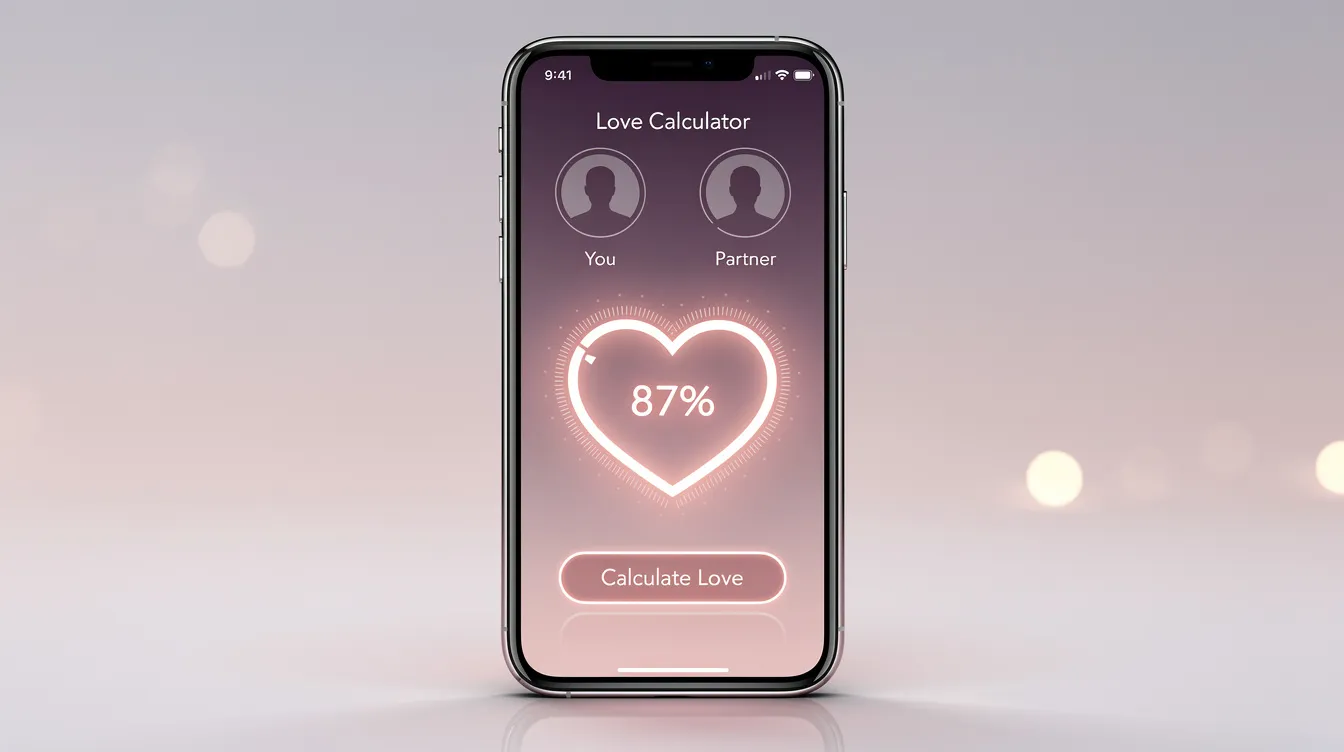
Finding potential matches with AI love calculators has never been easier—or more insightful. Thanks to cutting edge AI technology, these tools go far beyond the surface, using advanced algorithms to analyze personality traits, communication styles, and relationship dynamics. By simply entering two names, users can instantly receive a personalized love test that delivers a compatibility percentage and tailored relationship advice.
What sets AI love calculators apart is their ability to provide ai powered insights that help users discover true love and meaningful connections. The analysis doesn’t stop at names; many calculators also factor in zodiac signs, preferences, and even subtle nuances in how you and a potential partner communicate. This comprehensive approach means you’re not just getting a random score—you’re receiving accurate, data-driven predictions about your love compatibility.
For those searching for potential matches, these AI tools offer a smarter way to find someone special. By understanding your own personality traits and relationship needs, you can make more informed decisions about who might be the right partner for you. Whether you’re curious about a new connection or want to see if the stars align with your crush, AI love calculators help you discover compatibility and spark new relationships with confidence.
With thousands of users turning to AI love calculators to find and understand their ideal match, it’s clear that these tools are transforming the way we approach love. By leveraging advanced ai and personalized insights, you can navigate the world of dating with greater clarity—making the journey to true love both fun and rewarding.
The Concept of Love Percentage
One of the most intriguing features of today’s ai love calculator is the love percentage—a simple yet powerful way to visualize your compatibility with someone special. Powered by cutting edge ai technology, this love test goes far beyond the old-school “two names in a heart” approach. Instead, it uses advanced artificial intelligence to analyze personality traits, relationship dynamics, communication styles, and even zodiac signs, delivering ai powered insights that help you understand your relationship on a deeper level.
So, how does it work? When you enter two names into the love calculator, the tool gets to work analyzing the unique vibration and harmony between those names, along with any additional details you provide—like preferences, age, or zodiac signs. The ai then processes this information, drawing on vast data sets and sophisticated algorithms to generate a compatibility percentage. This love percentage, ranging from 0 to 100, reflects the potential connection and harmony between you and your partner, friend, or even a potential match.
But the love percentage is more than just a number. The ai love calculator provides a detailed analysis of your relationship dynamics, highlighting strengths, potential challenges, and areas where you naturally click. You’ll receive personalized relationship advice and insights tailored to your unique bond, making it easier to understand what makes your connection special—and how you can strengthen it further.
What’s especially fun about the love calculator is its versatility. While it’s perfect for exploring romantic compatibility and discovering your true love potential, it’s also a great tool for friends looking to see how well they match, or for sparking lively conversations at parties and social gatherings. Thousands of users turn to the love calculator not just for entertainment, but for accurate, data-driven insights that help them navigate the complexities of modern relationships.
Whether you’re curious about a new crush, want to deepen your bond with your partner, or simply enjoy discovering connections with friends, the ai love calculator offers a unique blend of fun and science. By leveraging advanced ai and machine learning, it delivers compatibility percentages and relationship insights that are both engaging and meaningful—helping you find, understand, and strengthen the connections that matter most.
Are AI Love Tests Actually Accurate?
Let’s address this directly: AI can improve accuracy over simple quizzes, but it cannot guarantee future relationship outcomes. Understanding both strengths and limitations helps set appropriate expectations.

Strengths of AI compatibility analysis:
- Data-driven pattern recognition drawing from thousands of similar cases
- Consistent application of the same analytical rules across all users
- Ability to spot subtle patterns that humans might overlook
- Some research suggests 20–30% better outcome prediction compared to random matching
Limitations to acknowledge:
- AI cannot see nonverbal cues like facial expressions or body language
- Day-to-day context and unique personal histories remain invisible
- Trauma, growth, and life circumstances strongly influence relationships in ways data can’t fully capture
Important clarifications:
- Outcome predictions are probabilities, not certainties
- A “high risk of conflict” score doesn’t mean the relationship will fail
- Compatibility doesn’t equal similarity—sometimes two similar personality types clash more than complementary ones
Healthy use: treat AI compatibility accuracy as a way to gain conversation topics and self-awareness, not as a final verdict on your relationship.
The quality of results depends heavily on honest, detailed input. Thoughtful responses yield more accurate insights than rushed or vague answers.
Using AI Love Calculators for Personal Growth
AI love calculators aren’t just about finding the perfect match—they’re also powerful tools for personal growth and self-discovery. By analyzing your personality traits, communication styles, and relationship dynamics, these calculators offer valuable insights into who you are and what you truly want in a relationship.
When you use an AI love calculator, you receive more than just a love percentage. The tool provides customized recommendations that highlight your strengths and suggest areas for improvement, helping you become a better partner and build stronger connections. Whether you’re in a relationship or exploring new possibilities, these insights can guide you toward healthier communication and deeper understanding.
Artificial intelligence excels at identifying patterns you might not notice on your own. By reflecting on the compatibility scores and relationship advice provided, you can discover new aspects of yourself and your approach to love. This self-awareness is key to personal growth, empowering you to work on your relationship skills and create more meaningful bonds with others.
Ultimately, using AI love calculators as a tool for self-improvement can lead to more fulfilling relationships. By embracing the insights and recommendations offered, you’re taking proactive steps to strengthen your connection with your partner—and with yourself.
How AI Could Change the Future of Dating
AI dating technology is moving from novelty to mainstream utility. Thanks to pre-built features and swift development processes, new AI-powered dating tools can rapidly transition from idea to fully functional applications. Several developments are likely over the next few years.
Predictive compatibility matching:
- Dating apps matching people based on values and communication patterns rather than just photos
- Pre-screening for long-term compatibility instead of short-term attraction alone
- Emotional needs alignment becoming a matching factor
Real-time relationship feedback:
- Tools helping partners interpret tense messages before responding
- Suggestions for calmer phrasing during heated exchanges
- Pattern alerts when recurring arguments emerge
AI matchmaking technology:
- Screening for potential matches based on conflict resolution compatibility
- Identifying users likely to form stable long-term relationships
- Reducing time wasted on fundamentally incompatible connections
Emotional intelligence modeling:
- Future AIs estimating how well partners handle stress together
- Empathy and care patterns tracked over time
- Combined data from both partners creating relationship health metrics
Concrete scenario: A couple uses a tool like Jeter AI every few months as a “relationship checkup,” tracking communication patterns and identifying drift before it becomes serious conflict.
These developments represent realistic short- to medium-term possibilities rather than science fiction.
Should You Trust AI Compatibility Tests?
Many people remain unsure whether to trust AI with something as personal as true love and relationship decisions. This skepticism is healthy—AI tools deserve careful evaluation.
Key advantages:
- Deeper insights than simple quizzes based on real behavioral patterns
- Ability to spot dynamics couples might overlook in daily life
- Structured feedback that can guide better conversations
- Objective analysis without the emotional bias partners might have
Key risks:
- Over-reliance on scores instead of genuine connection
- Treating AI as an authority rather than one tool among many
- Ignoring personal intuition or lived experience in favor of algorithms
- Potential bias in training data affecting recommendations
Best practices for using AI relationship advice:
- Use more than one tool and compare insights
- Check AI results against how you actually feel
- Discuss results openly with your partner as conversation starters
- Never let a score override genuine compatibility you experience
Privacy and transparency matter significantly. Choose tools like Jeter AI that clearly explain how data is used and stored. Look for no-permanent-storage commitments and encryption policies before sharing personal information.
Final Thoughts
AI isn’t replacing human connection—it’s offering a more detailed mirror to understand relationship dynamics. The journey from simple love calculators asking for two names to sophisticated AI relationship compatibility analysis represents genuine progress in self-awareness tools.
Think of AI compatibility tests as conversation starters and reflection prompts rather than destiny calculators. The goal isn’t to find a score that validates or invalidates your relationship. It’s to discover patterns worth discussing and understanding.
Ready to see what AI powered insights reveal about your relationship patterns? Try Jeter AI’s compatibility experience at https://jeter.ai/compatibility/ for a practical taste of cutting edge AI technology applied to love.
For more on how assessing compatibility before meeting can make a difference, see Compatibility vs. Chemistry Before the First Date: Why Pre-Date Assessment Saves Time & Reduces Dating Burnout.
Final Recommendations for Using AI Love Calculators
When it comes to using AI love calculators, a balanced approach is key. These tools are designed to be both entertaining and insightful, offering users a fun way to explore love, compatibility, and personal growth. To get the most accurate and meaningful results, always enter honest information—whether it’s your names, zodiac signs, or personal preferences.
Remember, while AI love calculators can provide valuable relationship insights and help you discover potential matches, they’re not a substitute for real-life connection and communication. Use them as a starting point for self-discovery and as a tool to spark conversations with your partner or friends. The love percentage and compatibility scores are meant to guide you, not define your relationship.
With thousands of users enjoying the benefits of AI love calculators, it’s clear these tools can help you find love, strengthen your bond, and have fun along the way. Whether you’re looking to discover new connections, gain deeper insights into your relationship, or simply enjoy a bit of entertainment, AI love calculators are designed to make the journey both enjoyable and enlightening.
So go ahead—enter your names, explore your zodiac compatibility, and see what AI-powered insights await. You might just discover a new perspective on love and relationships, and perhaps even find your perfect match.

FAQ: AI Compatibility Calculators and Love Tests
How do AI love tests work? AI love tests process user inputs—questions, text descriptions, or chat samples—through pattern recognition and natural language analysis. The AI identifies communication styles, personality traits, and relationship patterns, then outputs compatibility scores alongside narrative insights explaining strengths and potential friction points.
Are AI compatibility calculators accurate? AI compatibility calculators can be more insightful than random quizzes because they analyze actual behavioral patterns rather than generic categories. However, accuracy depends heavily on the quality and honesty of user input. Results are probabilistic assessments, not guarantees.
Can AI predict relationship success? AI can highlight risk factors and relationship strengths based on patterns from similar couples, but it cannot fully predict future choices, personal growth, or external events. Think of AI predictions as informed estimates rather than certain outcomes.
What is the best compatibility test? The best compatibility test is transparent about its methodology, evidence-informed in its approach, and respectful of user privacy. Jeter AI represents an AI-driven option designed with these principles, analyzing communication patterns rather than relying on zodiac signs or name calculations.
How does AI analyze relationship compatibility? AI analyzes relationship compatibility through personality modeling, communication-style analysis, emotional tone detection, and comparison to known relationship patterns. These methods combine to create a multidimensional picture of how two people might interact over time.
Is my data safe with AI love calculators? Data safety varies by platform. Look for clear privacy policies, encryption commitments, and no-permanent-storage guarantees. Jeter AI is designed with privacy-conscious users in mind, processing data without permanent storage or third-party sharing.
Can couples use AI tests together? Absolutely. Partners can take tests together and treat results as prompts for meaningful discussion rather than evidence in an argument. Sharing AI insights openly often leads to better conversations about expectations, communication preferences, and relationship goals.
Get started with Jeter Ai’s Compatibility Test before your first date


