First Date Questions Checklist: The Best Questions to Ask Before Meeting Someone
Most people think first dates fail due to “bad chemistry,” but the truth is they often
22 min read
Most people think first dates fail because of “bad chemistry.” In reality, they fail because incompatible people agree to meet without enough information.
The average dater spends 5–10 hours texting before a first date, yet Pew Research shows that most of those conversations stay surface level—memes, banter, and small talk that create false compatibility signals. Engaging in meaningful conversations during early dating stages can help daters quickly discern compatibility and identify any dealbreakers, ensuring a more efficient dating experience. But most people skip this step entirely.
Think of it like a job interview that feels great but leads to a bad hire. Attraction is often mistaken for alignment. You vibe over texts, show up excited, and then slowly realize you want completely different things from life. The goal of pre-date questions isn’t to impress someone—it’s to pre-qualify compatibility so you’re not wasting evenings on mismatched dates. The right first date questions serve as an effective ice breaker, helping break the ice and create a positive first impression, making the initial meeting more comfortable and insightful.
Jeter AI is built around this exact philosophy: a compatibility-first dating platform that helps you filter for real alignment before the first date through science-backed assessments.
Here’s the key idea: A successful first date is less about finding out if you like someone and more about confirming you should meet them in the first place.
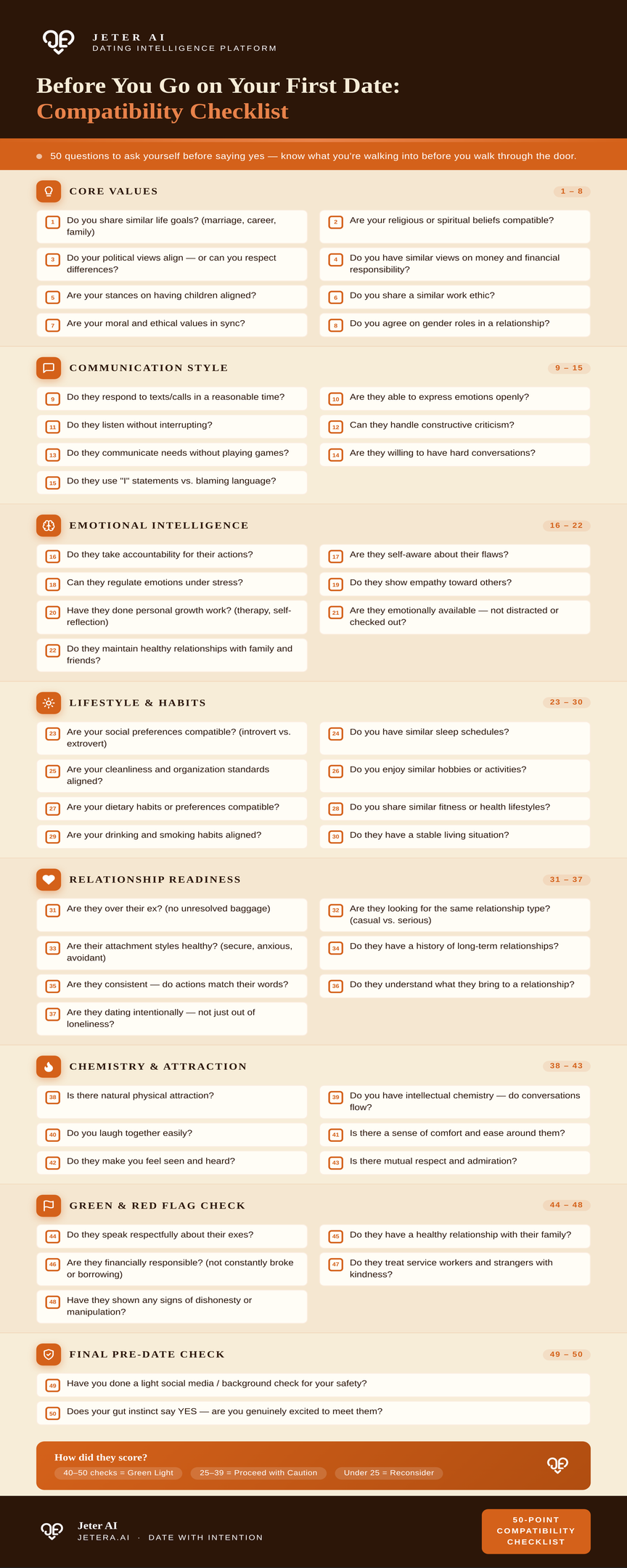
Use this first date compatibility checklist to ask better questions, identify red flags early, and build stronger romantic connections before meeting in person.
This guide is grounded in behavioral psychology principles like decision filtering, choice overload, and cognitive biases such as the halo effect, which causes us to assume attractive or funny people are also compatible.
Real-world data supports this approach. Match’s Singles in America reports consistently show that people who align on relationship goals early report higher satisfaction. Meanwhile, swipe fatigue and ghosting have become common—a mismatch between “looking for relationship” labels and actual behavior.
Most daters spend hours texting but keep conversations surface level, rarely moving beyond small talk. Using conversation starters can help break this pattern and initiate more meaningful discussions that reveal true compatibility.
Assessing compatibility early in dating involves asking open-ended questions that reveal core values, emotional availability, and lifestyle preferences, helping identify potential dealbreakers. Effective compatibility assessment focuses on three key areas: emotional intelligence, communication styles, and shared values, which are crucial for long-term relationship success.
Jeter AI’s compatibility assessments are built on relationship communication research and long-term outcome predictors. Learn more about the science.
Key benefits of pre-date questions:
Reduces emotional burnout from dead-end dates
Prevents mismatched expectations from dragging on for months
For example, asking “What does a fulfilling weekend look like for you?” can quickly reveal lifestyle compatibility and help both people decide if their priorities align.
Pre-date questions complement compatibility tools rather than replace them. Think of Jeter AI as the “X-ray” before you meet in person.
The Core Principle — Questions Are Filters, Not Interviews
There are two mindsets when asking date questions. Most people ask questions just to keep conversation flowing. High-quality daters ask questions as intentional filters.
The difference matters. First dates involve balancing lighthearted fun and assessing long-term compatibility. The best questions help you understand if someone fits how you want to spend your free time, how they relate to their closest friend or best friend, and how they move through daily life—not just their highlight reel. Asking open-ended questions on a first date can help keep the conversation flowing and reveal deeper insights about each other. Prompts that encourage your date to describe a person, memory, or trait—such as “Can you describe a moment that shaped who you are?”—often lead to more meaningful and revealing conversations that foster open communication between both people.
Simple rule: If a question doesn’t help you decide whether to meet them, it’s probably noise.
Asking open-ended questions that prompt storytelling can enhance conversation quality during a date. The goal is meaningful conversation, not rapid-fire trivia, and filter questions encourage open communication.
Jeter AI’s compatibility test already covers deeper questions like values, communication style, and dealbreakers. Your pre-date chat can focus on confirming that alignment.
Filter questions can still be fun, playful, and organic. This isn’t about being clinical—it’s about being curious with purpose.
The 5 Categories of First Date Questions That Actually Matter
Instead of memorizing 50 random questions to ask, focus on five core categories that map to long-term compatibility. Starting with ice breaking questions can help set a comfortable tone before moving into deeper topics. Deeper questions can help gauge long-term potential in a relationship once comfort is established. For example, asking about the one thing someone would change or prioritize in their life is a meaningful way to spark personal reflection and reveal what truly matters to them.
The five categories:
Use these before the first date (in chat or voice notes) and during the meetup to keep conversation flowing with purpose. For more on turning that first meeting into a real connection, see Jeter’s first-date guide.
These questions adapt to different settings—whether it’s a coffee date, a walk in your favorite place, a virtual date, or compatibility-matched singles events.
This category reveals how someone actually lives day-to-day, beyond the curated profile. Understanding how someone spends their time is crucial for assessing early common ground.
Questions to ask:
“What does a typical weekday look like for you?”
“Are you more structured or spontaneous with your time?”
“How do you usually spend your weekends?”
“What’s something you spend a lot of time on right now?”
“Are you more of a morning person or night owl?”
“Are you more of a homebody or out-every-night person?”
“What’s the most spontaneous thing you’ve ever done?”
Effective first date topics include hobbies, travel stories, favorite comfort foods, and childhood memories to reveal personality without feeling like an interrogation. Mixing in fun questions—like quirky “would you rather” prompts or lighthearted hypotheticals—keeps the conversation relaxed and engaging while helping you learn about each other’s lifestyle. Questions about personal interests, such as favorite books or hobbies, can lead to engaging conversations and help uncover shared interests.
What to listen for:
Routine vs chaos indicators
Work life balance signals
Social energy (introvert/extrovert alignment)
Whether their version of fun overlaps with your free time
Red flags:
Extremely vague answers like “I just go with the flow” with no detail
No hobbies or interests mentioned
A schedule that makes quality time impossible
This connects directly to choosing the right singles events—wine bar mixers for evening socializers, outdoor activities for active daters.
Share your own routine too. This keeps it feeling like a conversation, not a lifestyle interrogation.
2. Intentions & Dating Goals (Alignment Filter)
Most dating disappointment comes from an intentions gap. One person sitting across from you wants a serious relationship; the other wants something casual but won’t say it clearly.
Questions to ask:
“What made you start dating again recently?”
“Are you looking for something casual, something serious, or still figuring it out?”
“What does a good relationship look like for you at this stage?”
“How do you know when you want to move from dating to exclusive?”
“What’s the best relationship you’ve seen up close?”
“I’m just seeing what happens” repeated without depth
Extreme avoidance of defining intent
Answers that feel rehearsed and non-specific
Research consistently shows people are more satisfied when partners share relationship goals. The Gottman Institute emphasizes that aligned intentions predict relationship longevity.
Jeter AI’s compatibility test includes questions about commitment style and dealbreakers, helping clarify intentions before you ask them directly.
Chemistry and shared favorite foods are fun, but core values determine if a romantic relationship is sustainable beyond the honeymoon phase. Inquiring about life values, personal beliefs, and broader beliefs can provide insight into a person’s character and how they navigate the world, making it a meaningful topic for first dates.
Questions to ask:
“What’s something you believe that most people around you disagree with?”
“What shaped you the most growing up—an experience, a person, or a place?”
“What do you care about more than most people in your life do?”
“What kind of people do you naturally gravitate toward?”
“When you think of your closest friend, what do you value most about them?”
“Is there a cause or social issue you’d put on your personal bucket list?”
“What’s your guilty pleasure TV show or movie?”
What to listen for:
Emotional depth and self-awareness
Ability to reflect on a favorite childhood memory or formative experience
How they talk about money, family, and what they find interesting
By the second or third date, once trust has been built, it’s appropriate to ask deeper questions about values, relationships, and life approaches.
Red flags:
Parroting socially acceptable positions without nuance
Jeter AI’s assessments focus heavily on values alignment—finances, family, lifestyle priorities—to avoid discovering major misalignments months into dating. Learn how it works.
4. Future Direction & Life Trajectory (Long-Term Fit Check)
Many “almost” relationships fall apart not because of lost love, but because life trajectories never matched. One wants to move every year; the other wants to plant roots.
Questions to ask:
“Where do you see yourself living in the next few years?”
“What are you currently building or working toward?”
“What’s something you want to change about your life?”
“What does success look like for you right now?”
“Is travel on your bucket list as a lifestyle or occasional adventure?”
“What are your life goals?”
Asking about personal goals and aspirations, like “What do you want to achieve in life?” or “What are your life goals?” can reveal a person’s motivations and future outlook, which is crucial for deeper connections. These conversations can also help you decide if a second date is worthwhile, as they set the stage for more meaningful discussions about values and long-term compatibility.
What to listen for:
Ambition level and growth mindset
Attitudes toward stability vs constant change
Whether their future plans leave room for a serious partner
Geographic flexibility
Red flags:
No direction at all (“I don’t really think about the future”)
Wildly unrealistic goals with no steps
Strong preferences that contradict your non negotiables
Jeter AI helps spot trajectory mismatches before you get emotionally invested. See pricing for the token-based compatibility reports.
5. Emotional Intelligence & Relationship Behavior
Emotional intelligence, communication skills, and conflict style strongly predict healthy relationship outcomes—often more than hobbies or attraction. The Gottman Institute’s research on “The Four Horsemen” shows that contempt, defensiveness, and stonewalling patterns predict relationship failure.
Questions to ask:
“What makes you feel really understood by someone?”
“What’s something you’ve learned from your last relationship?”
“What does emotional support look like for you on a hard day?”
“When was the last time you apologized to someone?”
“What’s the most embarrassing thing that’s ever happened to you?”
Questions about family dynamics, such as “What’s your relationship like with your family?” can help assess emotional intelligence and compatibility.
What to listen for:
Accountability vs constant blame
Ability to name emotions
How they talk about exes, family, and their best friend
Willingness to grow and repair
Red flags:
Describing all exes as “crazy”
Bragging about never apologizing
Chronic avoidance of conflict
Mocking therapy or emotional work
Jeter AI’s compatibility test and love tests dig specifically into attachment tendencies and communication style.
5 Real User Stories (Experience-Based E-E-A-T Proof Section)
The following five short stories (composite, anonymized) show how asking one or two better questions changed the outcome of an almost-first date. These are based on common patterns Jeter AI users report when they use deeper pre-date filters.
1. The “Best Gift” Question That Sparked Real ConnectionMaya and Alex matched on a Sunday and were both tired of small talk. Before meeting, Maya asked Alex, “What’s the best gift you’ve ever received?” Alex paused, then shared a story about a handmade scrapbook his sister gave him after a tough year. This led to a meaningful conversation about family, gratitude, and what truly matters to each of them, and helped prevent any awkward silence so the conversation flowed naturally. By the time they met for coffee, they already felt a sense of emotional intimacy and curiosity about each other’s values.
2. The “Dealbreaker” RevealChris and Jamie were both excited for their first date, but Jamie decided to ask about dealbreakers before meeting. Chris admitted he wanted kids someday, while Jamie was firmly childfree. They realized their core values didn’t align, saving them both time and emotional energy.
3. The “What’s Your Ideal Weekend?” FilterPriya and Sam swapped stories about their favorite ways to spend a Saturday. Priya loved hiking and live music, while Sam preferred quiet nights in. They realized their lifestyles were a mismatch, but appreciated the honesty and clarity before investing in a date.
4. The “attachment style” ConversationTaylor asked Morgan about their attachment style after reading about it on Jeter’s blog. Morgan shared they were working on being more secure after past relationships. This vulnerability set the tone for a supportive, open first date.5. The “Biggest Lesson Learned” OpenerJordan and Lee connected over a question about the biggest lesson they’d learned from a past relationship. Their conversation was honest and insightful, helping them both feel seen and understood before they even met in person.
Story 1 — The “Perfect Chemistry” Mismatch
Two people texted for a week—memes, flirty banter, intense chemistry. Before confirming a Friday night date, one asked: “What does a typical weekday look like for you?”
The answer revealed a nightlife-heavy lifestyle: clubs until 3 a.m., sleeping late, freelance work with no structure. The asker had a structured 9–5 job and early gym mornings.
Outcome: They skipped the date. Their daily rhythms would constantly clash, and this lifestyle difference was a deal breaker for both.
Lesson: Chemistry doesn’t equal compatibility. Lifestyle misalignment can be a deal breaker that makes even exciting first dates fade fast.
Story 2 — The Intentions Gap That Saved Months of Confusion
A dater in their early 30s in Chicago, ready for a serious relationship, asked after a few days of chatting: “What are you hoping to find right now?”
The match responded honestly: “Nothing serious, just casual dating while I focus on my career and travel.”
Outcome: Instead of trying to change their mind over three months, the user thanked them for clarity and chose not to meet.
Lesson: Clear, early questions about intentions save months of emotional whiplash and can significantly improve your overall dating experience. This is exactly why Jeter AI emphasizes intentional dating.
Story 3 — The Conflict Style Red Flag
Someone with a pattern of emotionally unavailable partners tried a new approach. They asked: “How do you usually handle conflict?”
The response: “I usually just shut down and stop talking until it blows over. I hate drama.”
Outcome: Recognizing this as emotional avoidance, they passed on the date.
Lesson: Avoidant conflict styles rarely improve without self-awareness. Seeing this early lets you opt out before attachment and reinforces the importance of recognizing and maintaining your personal boundaries.
Story 4 — The Life Direction Split
Two late-20s daters matched and discovered shared interests—travel, favorite foods, live music. Then one asked: “Where do you see yourself in a few years?”
One wanted to live as a digital nomad, moving every 6–12 months. The other wanted to buy a home near family. Different trajectories entirely.
Outcome: They mutually agreed not to meet. Even a fun first date couldn’t change the logistics mismatch.
Lesson: Sometimes the most respectful choice is recognizing you’re not on the same page and stepping aside early.
Story 5 — The First Date That Felt Effortless
Two intentional daters completed a Jeter AI compatibility test before meeting and shared their results. They already knew their intentions, lifestyle rhythms, and emotional communication styles were compatible.
When they met at a quiet wine bar in Boston, the date felt like a continuation of a deeper conversation, not a high-pressure evaluation.
Outcome: Both reported the date felt low-anxiety and authentic, noting that the compatibility test helped create a comfortable environment for open conversation. They weren’t deciphering basic compatibility on the spot.
Lesson: When you use tools and questions to pre-clarify the big things, the first date can actually be fun and relaxed. Learn how the compatibility test works.
How to Ask These Questions Naturally (Without Making It Weird)
You don’t need to sound like a therapist or HR manager. The goal is natural, curious conversation—not a scripted job interview.
Practical tips:
Don’t ask all heavy questions at once—space them over a few days of texting
Use curiosity-based phrasing: “I’m curious how you…” or “What’s your favorite thing about…”
Answer yourself first to keep it two-sided
Pay close attention to their answers and ask follow up questions
Notice their body language as well as their words—nonverbal cues can tell you a lot about how they feel during the conversation
Active listening involves paying close attention to answers and asking follow-up questions. Experts suggest moving from broader topics to more meaningful inquiries to build rapport during conversations.
Light-hearted questions lower defenses, make space for laughter, and ease both individuals into sharing, creating a comfortable atmosphere on a first date. Asking fun questions on a first date helps to build rapport and allows both individuals to discover common interests in a relaxed manner. Light-hearted questions can reveal a person’s sense of humor and personality, making it easier to gauge compatibility and connection.
Avoid “checklist energy.” Focus on building on what they say—turn a meme exchange into a values question, or small talk about work into “What does a typical weekday look like for you?”
For more on timing, see how long to chat before a first date.
Red Flags You Can Identify Before Meeting
Some incompatibilities are obvious in how people respond to reasonable questions. Spotting them early protects your time and emotional energy.
Key red flags:
Avoidance of direct answers
Overly generic responses (“I like everything, I’m down for whatever”)
Inconsistent stories about work or relationships
Constant sarcasm when you ask deeper questions
No curiosity about you in return
Describing their longest relationship ending as entirely the other person’s fault
Pay close attention not just to what they say, but how. Do they get defensive or dismissive when asked about feelings or when you bring up uncomfortable questions? That’s a red flag worth noting.
Log patterns over a few days rather than judging one awkward message. Repeated resistance to any deeper or uncomfortable questions is important data.
It’s okay to politely end the conversation when major red flags appear. This is intentional dating, not being “too picky.”
Green Flags That Indicate Strong Compatibility
Green flags are things to actively look for—not just the absence of bad habits or red flag signals.
Key green flags:
Balanced conversation flow—they ask thoughtful questions back
Open, specific answers with personal examples
Comfort sharing minor vulnerabilities
Consistency in what they say over time
They remember details you share and follow up on them
Solid relationship with at least one best friend or closest friend
Speak respectfully about exes and family
Positive attitude
Notice how you feel after chatting: more grounded and seen, or anxious and confused? Start thinking about keeping notes after early conversations.
Compatibility-matched speed dating amplifies these green flags by pre-filtering for alignment before you ever speak.
The Simple Pre-Date Filtering Framework
Use this five-step framework before every next date as a quick checklist—applied flexibly, not rigidly.
Step 1: Lifestyle alignment Confirm weekday routines and weekend habits don’t directly conflict. Ask 1–2 lifestyle questions. Does their version of fun work with yours?
Step 2: Intent clarity Get an honest feel for whether they want casual, serious, or are uncertain. Is that on the same page as your goals?
Step 3: Values exploration Ask one or two values questions. What do they care about? How do they treat important people? What do they stand for?
Step 4: Emotional intelligence check Include at least one question around conflict or past learning. Do they show accountability and maturity?
Step 5: Mutual curiosity test If you’ve asked fair, open ended questions and gotten thoughtful answers, check whether they show the same curiosity about you. One-sided curiosity is a sign to pause.
Pair this framework with Jeter AI’s compatibility report and use a dating app to streamline your pre-date filtering process. See pricing for token packages.
Final Thoughts — Better Questions Create Better Outcomes
You don’t need hundreds of clever right questions. You need a focused set that reveal lifestyle, intentions, values, trajectory, and emotional intelligence. These are the dimensions that matter for an authentic connection.
The goal of dating isn’t to meet more people—it’s to meet the right people faster, with less burnout and fewer dead-end almost-relationships. The most important lesson from intentional daters: asking better questions reduces emotional exhaustion, improves compatibility accuracy, creates safer experiences, and increases the chance of finding a partner whose life actually fits yours.
Try Jeter AI’s free compatibility assessment before your next date to see where you align on key dimensions. It’s a practical next step that takes the guesswork out of compatibility.
Treat first date questions as an act of self-respect and respect for others. Using thoughtful first impression questions helps set the tone for a positive and authentic connection. Show up honestly, with curiosity, and a willingness to walk away when alignment isn’t there. The rest of your life in a relationship depends on who you choose to spend it with.
Intentional questions today lead to a more compatible, fulfilling relationship tomorrow.
Frequently Asked Questions (FAQs)
Q1: How many first date questions should I ask before meeting?
It’s best to ask 5–10 thoughtful questions spread out over your pre-date conversations. This keeps the chat natural and prevents it from feeling like an interrogation. Focus on questions that help you decide if meeting is worth your time.
Q2: When is the right time to ask deeper questions on a date?
Deeper questions about values, intentions, and emotional intelligence are usually best introduced gradually—either during pre-date texting or by the second or third date once some trust is built.
Q3: What should I do if my date avoids answering important questions?Avoidance can be a red flag. If it happens repeatedly, it’s okay to reconsider meeting or continuing the conversation. Intentional dating means respecting your time and emotional energy.
Q4: Can I use compatibility tests alongside first date questions?
Absolutely. Tools like Jeter AI’s compatibility test complement your questions by providing a science-backed report on alignment before you meet.
Q5: How do I keep first date questions from feeling awkward or forced?
Ask questions naturally by sharing your own answers first, using curiosity-based phrasing, and spacing questions over time. Mixing lighthearted questions with deeper ones helps keep the vibe relaxed and engaging.
Be The First to Date Smarter
Join our pre-launch waitlist and get 6 free compatibility tokens ($15 value) at launch. Find out if there’s real compatibility before investing your time on dates.
No spam. Just early access and free compatibility tokens.
We’ll email you when Jeter AI is live.
We respect your inbox. No spam, just exciting updates.
Additional
Related Insights For You
Join thousands of daters moving from guesswork to guidance.
In 2025, two coworkers began dating after months of collaboration, but their
25 min read
FAQ
Frequently Asked Questions
Join thousands of daters moving from guesswork to guidance.
How do compatibility-based events work?
Before the event, participants complete the free Jeter compatibility assessment. For virtual speed dating, our AI matches you with compatible participants one hour before the event starts. For in-person events, you can share your compatibility link or QR code during conversations, then review compatibility insights after the event to decide who to follow up with.
Do I need to complete the assessment before attending an event?
Yes, for virtual speed dating events where we pre-match participants based on compatibility. For in-person events (mixers, themed nights), you can complete the assessment beforehand or create your profile at the event—but completing it in advance helps you share your compatibility link more easily and get better post-event insights.
What's the difference between virtual and in-person events?
Virtual speed dating happens online with video dates—you’re matched with compatible participants for 5-minute conversations. In-person events bring people together face-to-face at venues in your city (speed dating, mixers, themed nights). Both event types use compatibility insights to enhance connections, but virtual events emphasize pre-matching while in-person events focus on natural interaction with optional compatibility follow-up.
How much do events cost?
Event pricing varies by format, location, and type. Virtual speed dating events typically range from $25-$45. In-person events range from $35-$75 depending on the venue and format. All event pricing is clearly listed on individual event pages. The compatibility assessment is always free—you only pay for event attendance.
What happens after the event?
After any Jeter event, you can review match requests from people you connected with. If someone shared their compatibility link with you (or vice versa), you can unlock detailed compatibility insights using a Compatibility Token. This helps you decide who to follow up with based on actual alignment, not just first impressions. Match requests and compatibility links don’t expire, so review them whenever you’re ready.
We Value Your Privacy
We use cookies to improve your browsing experience, analyze site traffic, and personalize content. By clicking “Accept,” you agree to our use of cookies. You can manage your preferences or learn more in our Cookie Policy.
Functional
Always active
The technical storage or access is strictly necessary for the legitimate purpose of enabling the use of a specific service explicitly requested by the subscriber or user, or for the sole purpose of carrying out the transmission of a communication over an electronic communications network.
Preferences
The technical storage or access is necessary for the legitimate purpose of storing preferences that are not requested by the subscriber or user.
Statistics
The technical storage or access that is used exclusively for statistical purposes.The technical storage or access that is used exclusively for anonymous statistical purposes. Without a subpoena, voluntary compliance on the part of your Internet Service Provider, or additional records from a third party, information stored or retrieved for this purpose alone cannot usually be used to identify you.
Marketing
The technical storage or access is required to create user profiles to send advertising, or to track the user on a website or across several websites for similar marketing purposes.