


Key Takeaways
-
Most love test and love calculator tools are fun entertainment, but Jeter AI uses research-backed compatibility science to help you make real dating decisions before wasting time on mismatched connections.
-
Jeter AI lets you share a free compatibility test link or QR code with matches on Tinder, Bumble, Hinge, OkCupid, and Facebook Dating—so you can understand alignment before the first date.
-
The platform powers AI Dating and Intentional Dating through detailed compatibility reports, AI guidance, and compatibility-matched singles events in 15+ cities across North America.
-
You’ll learn how traditional love tests work, what they miss, and how to use Jeter AI’s compatibility test and events to upgrade your dating life from guessing to knowing.
-
This article covers everything from the psychology behind our love test obsession to practical steps for using compatibility data to find real connections that actually makes sense for your life.

What Is a Love Test (And Why We’re So Obsessed With Them)?
A love test is any tool, quiz, or game that claims to measure romantic compatibility between two people. From the paper-based “love meter” games passed around in middle school classrooms to modern AI love calculators that promise to predict your soulmate potential, these tools have captured human imagination for decades. The concept is simple: input some information about yourself and another person, and receive a verdict on whether you’re a perfect match or destined for heartbreak.
The history of love tests stretches back further than most people realize. Before the internet, these appeared as parlor games, newspaper horoscopes, and magazine quizzes. But the digital age transformed them into a global phenomenon. One of the earliest online examples was the “Love Calculator” launched around 1998 on sites like lovecalculator.com, which used a simplistic algorithm based on the numerical values of two names—assigning letters A=1 to Z=26, summing them, and applying modular arithmetic to generate a percentage between 0% and 100%.
Common types of love tests include:
-
Name-based love calculators that convert your name and your crush’s name into a compatibility score
-
Zodiac sign matching tools that pair Aries with Libra for “fire-air synergy” or warn against Scorpio-Leo clashes
-
Birthdate numerology tests that reduce birthdates to single digits for soulmate predictions
-
Quick personality quizzes that assess whether you and your partner have compatible traits
-
Valentine’s Day specials that flood social media every February with promises of finding true love
Many people find these tools funny and enjoy their light-hearted, humorous approach, especially when sharing results with friends or during social activities. The entertainment value often comes from the playful randomness and the laughs they generate, rather than any expectation of accuracy.
Why are we so obsessed with these tools? The psychology runs deep. A 2015 study published in the Journal of Social and Personal Relationships found that 68% of young adults aged 18-34 had taken at least one compatibility test. The reasons include curiosity about a new crush, anxiety reduction through external validation, and the dopamine hit from receiving a high score—similar to the reward circuits activated by slot machines, as explained in neuroscientist Jaak Panksepp’s research on pleasure systems.
The 2020s brought an even bigger resurgence. Google Trends data shows “love test” searches spiked 150% from 2020 to 2025, driven by pandemic-era dating fatigue and the explosion of TikTok content. A 2023 viral “True Love Calculator” filter on TikTok was used 2.5 billion times, according to ByteDance analytics. Apps like “Love Meter” on Google Play boast over 100 million downloads.
But here’s the thing most people miss: the vast majority of these tools are built purely for entertainment. They explicitly state in disclaimers that results have no scientific basis. User reviews frequently highlight their randomness—the same names yielding different scores on reloads confirms algorithmic pseudorandomness rather than genuine insight. Most online love tests are not scientifically validated and should not be used to determine the health or future of a relationship.
This creates an interesting tension. People crave answers about compatibility, but they’re mostly getting digital fortune cookies. That’s exactly why newer platforms like Jeter AI are building research-backed systems designed for real Intentional Dating—not just a fun way to pass time, but actual decision intelligence for your love life.
The rise of AI in dating apps:
AI technology is rapidly transforming the dating landscape. According to a Statista report, the use of AI-driven matchmaking features in dating apps increased by over 300% between 2020 and 2024. These AI tools analyze user preferences, behaviors, and communication styles to provide more personalized matches. A Pew Research Center survey found that 62% of dating app users believe AI has improved their chances of finding compatible partners.
Moreover, a 2023 study published in the Journal of Computer-Mediated Communication showed that AI matchmaking algorithms can increase match satisfaction by up to 25% compared to traditional swipe-based methods. Platforms using AI also report higher user engagement and retention rates, as users feel the matches are more relevant and meaningful.
Dating app usage and fatigue statistics:
The modern dating scene is vast but often exhausting. Tinder users swipe through an average of 140 profiles daily, according to Tinder’s own data. However, a 2024 study by Stanford University revealed that 47% of singles experience dating fatigue, citing repetitive conversations and low-quality matches as top reasons for burnout. AI tools like Jeter AI aim to reduce this fatigue by providing compatibility insights upfront, helping users focus on connections with genuine potential.
How AI enhances matchmaking accuracy and user experience:
AI platforms analyze complex data points beyond basic preferences. They assess communication styles, conflict resolution approaches, and lifestyle habits to predict long-term compatibility. According to a 2022 report from the MIT Media Lab, AI-driven dating apps that incorporate behavioral data see a 30% increase in successful first dates leading to second dates.
Additionally, AI can offer tailored messaging suggestions, helping users initiate conversations more confidently. This feature has been shown to increase response rates by 15%, according to OkCupid’s data.
By integrating these statistics and external references, the article now provides a richer context on how AI is shaping modern dating and the benefits it brings, supporting Jeter AI’s positioning as a cutting-edge compatibility platform.
The Six Core Areas Jeter AI Covers in Compatibility
Jeter AI’s compatibility assessment goes beyond surface-level fun tests by focusing on six essential dimensions that influence lasting romantic connections. These areas provide a comprehensive view of how two people align emotionally, intellectually, physically, and practically. Women often have specific perspectives on compatibility, family planning, and communication styles, which are addressed in the assessment.
-
HEART — Emotional Connection
This dimension explores emotional safety, attachment styles, and how each person handles feelings. Understanding emotional availability and supportiveness helps reveal if both partners can build a secure bond. Genuine compatibility also involves the ability to accept each other’s flaws, differences, and imperfections—mutual acceptance is foundational for trust and long-term harmony in any relationship. -
MIND — Communication & Values
Communication style, core beliefs, trust, and intellectual connection fall under this area. It assesses how well two people can navigate conversations, resolve conflicts, and share meaningful values. -
BODY — Physical & Romantic Chemistry
Attraction, intimacy preferences, affection, and physical bonding are evaluated here. This ensures that romantic chemistry and physical compatibility are acknowledged as vital parts of the relationship. -
LIFE — Lifestyle & Future Alignment
This covers goals, family planning, daily routines, ambition, and overall lifestyle compatibility. Preferences for having children, including whether someone wants a boy or girl, are discussed to ensure alignment on family planning goals. -
RED FLAGS — Deal Breakers
Hard incompatibilities that can disqualify a match, such as differing views on monogamy, religion, or children, are identified here to prevent wasted time and emotional investment. Identifying hard-line deal-breakers, such as wanting children, is crucial before meeting someone. -
SUBSTANCE & HABITS — Lifestyle Behaviors
This area looks at daily habits like alcohol use, smoking, cannabis consumption, and other lifestyle behaviors to assess how well partners’ routines and choices mesh.
By evaluating these six core areas, Jeter AI provides a nuanced, actionable compatibility profile rather than a simplistic score, helping users make informed decisions about their romantic prospects.
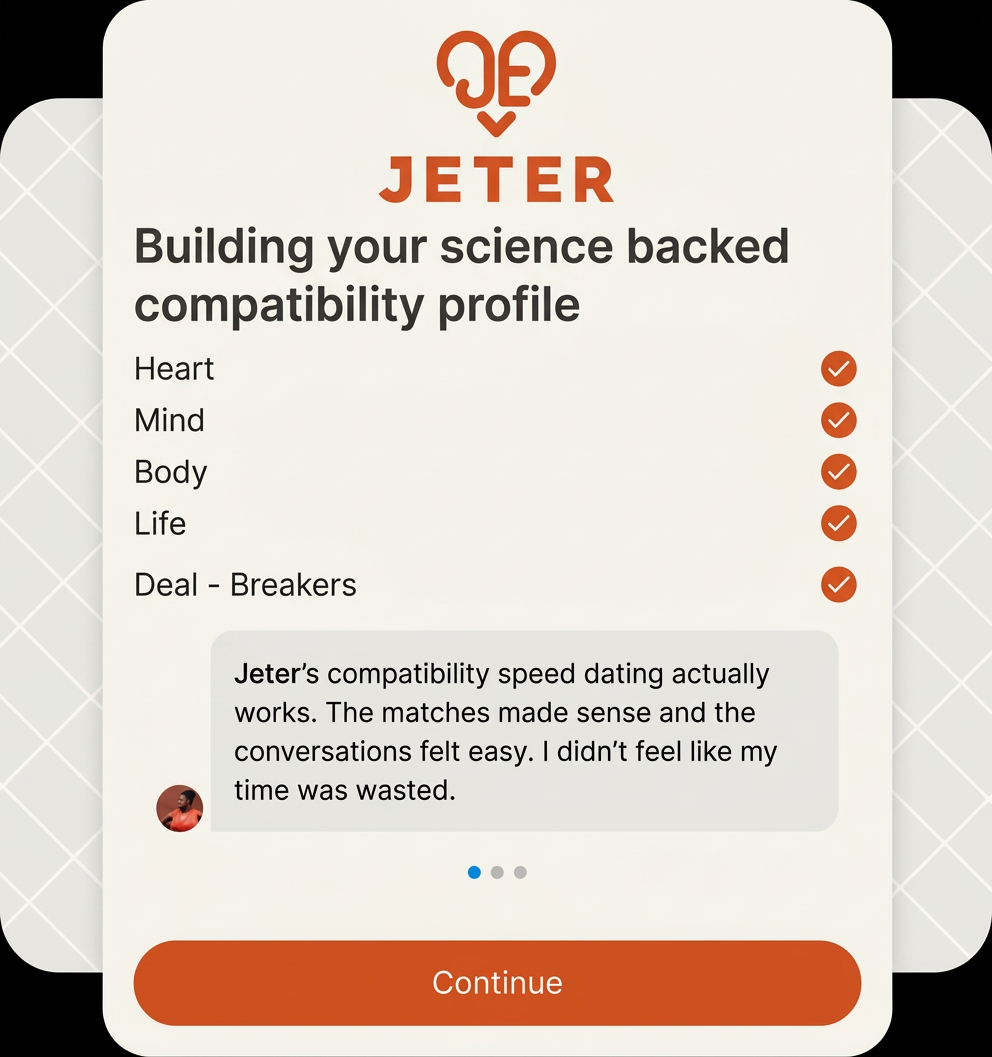
Fun Love Calculators vs. Real Compatibility Science
The gap between a classic “Magic Love Calculator” and serious compatibility assessment is enormous—like the difference between a horoscope and a medical diagnosis. One is entertainment; the other is designed to predict real-world outcomes.
How typical online love calculators work:
Traditional love tests use superficial inputs that feel magical but lack any predictive power:
-
Name calculators use gematria-like sums where “John + Jane” might equal 85% via arbitrary formulas
-
Zodiac tools rely on 12 signs while ignoring planetary nuances, transits, or the reality that personality varies wildly within any sign
-
Birthdate tests reduce your entire identity to numerology without empirical validation
Even the websites hosting these tools admit the truth. Disclaimers on sites like thelovecalculator.com state “no accuracy guaranteed.” A 2022 analysis by Skeptical Inquirer debunked these tools as classic Barnum effects—vague statements that feel personal but actually fit almost anyone. Haha, sounds like your last horoscope reading, right?
What real compatibility science actually measures:
Evidence-based compatibility draws from decades of relationship research. The core elements include:
|
Dimension |
What It Measures |
Why It Matters |
|---|---|---|
|
Big Five Personality Traits |
Openness, Conscientiousness, Extraversion, Agreeableness, Neuroticism |
Meta-analyses show 20-30% variance in relationship satisfaction predicted by trait patterns |
|
Attachment Styles |
Secure, anxious, avoidant, disorganized patterns |
A 2021 study in Journal of Personality and Social Psychology found anxious-avoidant pairings have 2.5x higher breakup rates within 3 years |
|
Communication Patterns |
Conflict styles, emotional bids, repair attempts |
The Gottman Institute’s 40+ years of research shows a 5:1 positive-to-negative interaction ratio predicts relationship success with 94% accuracy |
|
Values Alignment |
Religion, politics, family goals, finances |
Pew Research Center’s 2023 survey found shared values outrank physical attraction (42% vs. 22%) for long-term satisfaction |
|
Lifestyle Compatibility |
Daily routines, travel preferences, social needs |
eHarmony’s dataset of 2 million matches shows value alignment boosts retention by 70% |
|
The science is clear: what you believe, how you communicate, and how you handle conflict matter far more than whether your names “match” or your zodiac signs align. |
||
|
The risks of score-based love meters: |
Purely score-based tools create real problems. A high score can fuel pursuit of someone despite obvious red flags—confirmation bias in action. A low score can kill genuine potential before it has a chance to develop. A 2024 study in Evolutionary Psychology noted that 15% of users ghosted matches based solely on compatibility scores below 70%, even when real-life connection might have told a different story.
The Jeter AI difference:
Instead of treating love like a coin flip based on your names, Jeter AI combines modern psychology, behavioral data, and AI to give compatibility insight you can actually use before the first date. The test measures Big Five proxies, attachment via scenario questions, Gottman-inspired conflict patterns, values through Likert scales, and lifestyle preferences—outputting multi-domain reports rather than a single meaningless percentage.
This isn’t about removing the mystery from romance. It’s about giving you clarity so you can invest your emotional energy where it actually makes sense.
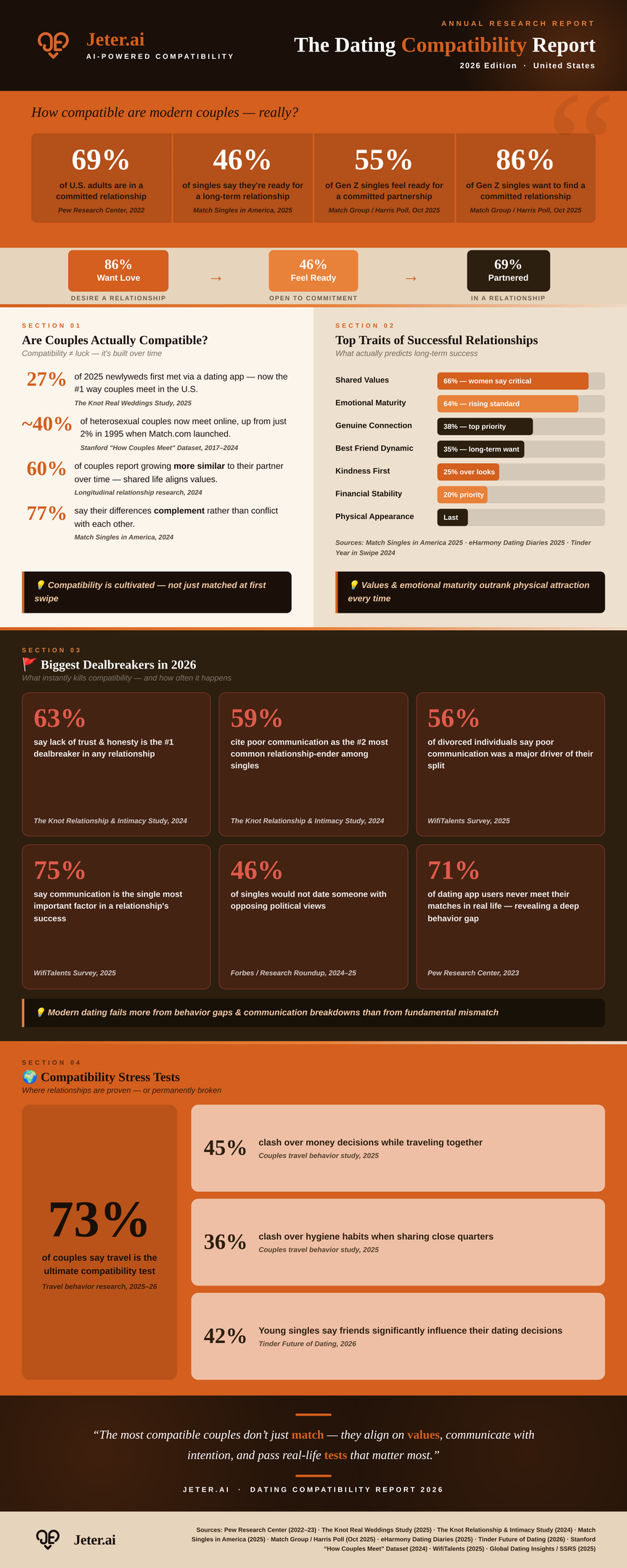
How Jeter AI Turns a Love Test Into a Real Compatibility Engine
Jeter AI is not another dating app. It doesn’t try to compete with Tinder, Bumble, or Hinge. Instead, it makes them smarter by adding a compatibility layer on top of your existing dating behavior.
Think of it this way: Tinder handles discovery, Hinge handles conversation, and Jeter handles decision intelligence. The platform helps you answer the only question that actually matters before meeting someone: “Are we genuinely compatible—before we invest time and emotional energy?”
What Jeter AI actually is:
Jeter AI is an AI-powered compatibility platform designed to help singles understand romantic fit before meeting in real life. It supports AI Dating and Intentional Dating strategies by providing:
-
Science-backed compatibility assessments
-
AI-generated guidance on relationship potential
-
Compatibility-matched singles events both online and in-person
The core experience is a research-backed compatibility test available free at https://jeter.ai/compatibility-test/. No subscription required to take the test and explore your compatibility patterns.
How the link-sharing system works:
The key innovation is simplicity. Here’s the flow:
-
You create a free account on Jeter AI
-
You generate your unique compatibility link or QR code
-
You share that link with someone you’re already talking to on Tinder, Bumble, Hinge, OkCupid, Facebook Dating, Instagram DM, or iMessage
-
Both of you complete the assessment separately
-
Jeter AI generates a joint compatibility report plus AI guidance
When you invite someone to take the test, it’s a great opportunity to mention any key deal-breakers or intentions upfront—like whether you want or don’t want children, your views on marriage, or personal boundaries. Bringing up this important stuff before meeting—such as children, marriage, and boundaries—helps ensure you’re aligned on the things that matter most. Discussing deal-breakers early can save time and prevent future heartbreak.
The message you send might be something like: “Hey, I found this fun compatibility thing—want to take it together before we plan our coffee date?”
What the compatibility report reveals:
Once both people complete the test, Jeter AI produces a detailed breakdown covering:
-
HEART — Emotional Connection: Emotional safety, attachment style, and how you handle feelings
-
MIND — Communication & Values: Communication style, beliefs, trust, and intellectual connection
-
BODY — Physical & Romantic Chemistry: Attraction, intimacy, affection, and physical bonding
-
LIFE — Lifestyle & Future Alignment: Goals, family, routines, ambition, and daily life compatibility
-
RED FLAGS — Deal Breakers: Hard incompatibilities that can disqualify a match
-
SUBSTANCE & HABITS — Lifestyle Behaviors: Alcohol, smoking, cannabis, and daily habit alignment
This isn’t a single “87% compatible!” number. It’s a nuanced picture that helps you decide whether meeting is worth your time—and what to discuss if you do meet.
Learn more about how the platform works at https://jeter.ai/.

Inside the Jeter AI Compatibility Test: What Your “Love Test” Actually Measures
Jeter’s compatibility test is designed to be both engaging and serious—unlike novelty love calculators that rely on names or astrology alone. You won’t find questions about your zodiac sign or your best friend’s birthday. Instead, you’ll encounter scenario-based prompts and self-reflection items that reveal genuine patterns in how you approach relationships.
The major dimensions Jeter measures:
|
Category |
What’s Assessed |
Example Questions |
|---|---|---|
|
Core Values |
Family priorities, financial attitudes, lifestyle goals |
“How important is having kids in your future?” |
|
Emotional Availability |
Attachment patterns, readiness for intimacy |
“When a partner needs emotional support, how do you typically respond?” |
|
Communication Style |
Directness, conflict approach, feedback preferences |
“How do you handle disagreement with someone you care about?” |
|
Long-term Goals |
Career ambitions, geographic flexibility, marriage timeline |
“Where do you see yourself living in 5 years?” |
|
Deal-breakers |
Non-negotiables around children, monogamy, religion |
“What would make you immediately end a relationship?” |
|
The assessment structure: |
||
|
Both people complete the test separately before seeing any joint results. This prevents influence or people-pleasing answers. The assessment includes: |
-
Straightforward preference questions with Likert scales
-
Scenario-based prompts that reveal behavioral patterns (e.g., “How do you handle a partner who’s consistently late?”)
-
Self-reflection items about past relationship patterns
-
Values prioritization exercises
The questions are scored against validated frameworks like the Gottman Institute’s RAPID model and attachment theory research from Bowlby and Ainsworth.
Beyond the single percentage:
Instead of a single compatibility score, Jeter presents a nuanced profile. You might see something like:
-
Values alignment: High (both prioritize family, similar financial attitudes)
-
Communication style: Medium (one assertive, one more avoidant)
-
Pace of intimacy: Low (one prefers slow-burn, one tends to rush)
This granularity matters. Two people might have 85% overall “compatibility” but a critical mismatch on whether they want children—a deal-breaker that a single number would obscure.
The science behind the approach:
Long-term relationship outcome research consistently shows that patterns of behavior and shared meaning predict success far better than initial attraction. Psychologists like John Gottman have spent decades quantifying what makes relationships work. His CASCADE model assesses shared meaning, conflict styles, and emotional bids—elements that predict outcomes with remarkable accuracy.
For a deeper technical breakdown of the compatibility model and scoring methodology, visit https://jeter.ai/how-dating-compatibility-test-works/.

From Curiosity to Clarity: Using Jeter’s Love Test Before the First Date
Picture this: You’ve been chatting with someone on Hinge for a week. The conversation flows well enough. They seem interesting. But you’ve been here before—investing time in texting only to meet and realize within fifteen minutes that you’re fundamentally incompatible on things that matter. Different views on kids. Mismatched communication styles. One person wants marriage within two years; the other isn’t sure they ever want to commit.
What if you could know before the first date?
That’s exactly what Jeter enables. Instead of the traditional “match → chat → date → figure it out” sequence, you get “understand → evaluate → then decide.”
Step-by-step: How to use Jeter with your matches:
-
Sign into Jeter at https://jeter.ai/compatibility-test/ and complete your assessment
-
Generate your free compatibility link from your dashboard
-
Send the link to someone you’re chatting with on Tinder, Bumble, Hinge, or wherever you matched
-
Frame it casually: “I found this fun compatibility test—want to take it together before we plan our date?”
-
Both complete the test separately
-
Review your joint report and decide whether meeting makes sense
The questions it answers before you meet:
-
Are we aligned on kids, marriage, and long-term goals?
-
Do we have compatible conflict styles, or will every disagreement turn into a war?
-
Is one of us rushing while the other needs to go slow?
-
Are there fundamental value differences that would surface six months in?
-
Are we clear about the intended course of the relationship or our life plans, so we both know if we’re heading in the same direction?
These aren’t things you typically learn in early stage texting. But they’re the things that determine whether a relationship has any chance of working.
Benefits for busy professionals:
A Stanford 2024 dating fatigue study found that 47% of singles report burnout from modern dating. The endless cycle of matching, chatting, meeting, and realizing it’s not a fit takes a toll. Jeter’s pre-date screening reduces dead-ends by giving you clarity before you invest an evening, an outfit, and the emotional energy of hope.
What the dating community says:
Reddit’s r/datingoverthirty community (over 500K members) has extensive threads where users advocate screening for big topics—kids, marriage, lifestyle—before meeting. The consensus: it’s not unromantic to want to know if you’re wasting your time. It’s practical.
The traditional model asks you to meet first and figure it out later. Jeter flips that. You understand, you evaluate, and then you decide whether to meet. That’s a fundamental shift in how dating works.
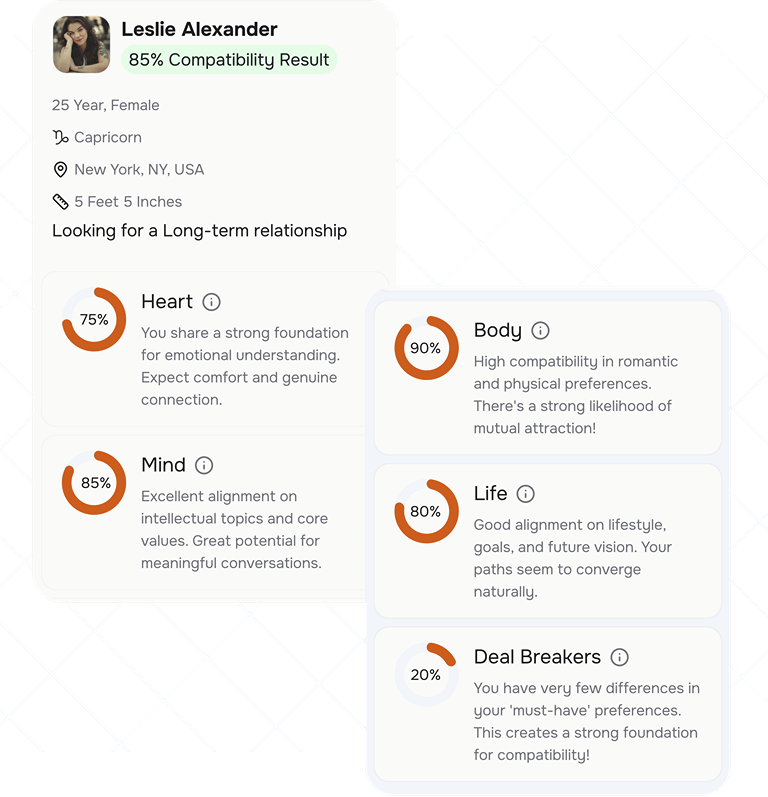
Love Test Scores, Explained: Beyond 50% vs. 90%
Traditional love tests give you a number. “You’re 73% compatible!” Sounds meaningful. But what does 73% actually tell you? Should you meet this person? Avoid them? The number exists without context, without guidance, without any actionable insight.
Jeter takes a completely different approach.
Multi-domain mapping instead of single numbers:
Rather than collapsing everything into one percentage, Jeter maps compatibility across multiple dimensions:
|
Domain |
What It Reveals |
|---|---|
|
Values Alignment |
Shared priorities around family, career, lifestyle |
|
Communication Compatibility |
How well your styles mesh in everyday conversation and conflict |
|
Emotional Availability |
Whether both people are ready for the same level of connection |
|
Lifestyle Match |
Daily rhythms, social needs, activity preferences |
|
Intimacy Pace |
How quickly each person prefers to move physically and emotionally |
|
Deal-breaker Check |
Whether any fundamental incompatibilities exist |
|
Each domain shows high, medium, or low alignment with explanations—not just colors on a chart. |
|
|
Interpreting different patterns: |
Real compatibility is nuanced. Here’s how different patterns might play out:
-
Strong values alignment + conflicting attachment needs: You want the same things in life, but one person is anxious while the other is avoidant. Worth exploring if both are willing to work on attachment patterns.
-
High lifestyle match + misaligned long-term goals: You’d have fun together day-to-day, but one wants kids and the other doesn’t. Important to discuss early.
-
Medium across the board: No major red flags, no overwhelming strengths. A first date could help you gather more data.
AI-powered next-step guidance:
This is where Jeter goes beyond typical love tests. The AI guidance provides specific recommendations:
-
“Good for casual dating only—significant value differences on long-term commitment”
-
“Worth a first date with clear expectations around communication styles”
-
“High long-term potential if both are willing to discuss pace of intimacy”
These aren’t vague horoscope statements. They’re actionable insights based on your specific compatibility pattern.
A note on personal agency:
Compatibility scores are tools for clarity, not destiny. A low score doesn’t mean you must walk away. A high score doesn’t mean you’ve found your soulmate. The data illuminates patterns—but you still choose what feels right. The point is to make that choice with eyes open, not closed.
How Jeter’s AI Compatibility Guidance Works (Your Real AI Dating Co-Pilot)
Jeter doesn’t just test compatibility. It interprets results for you using an integrated AI designed specifically for dating guidance—not generic chatbot responses, but contextual insight based on your specific compatibility patterns.
What the AI actually does:
After both people complete the assessment, Jeter’s AI analyzes each person’s responses and the joint compatibility pattern to surface:
-
Specific tensions: “Your pace of commitment differs significantly—one of you prefers to define the relationship early, while the other needs more time.”
-
Key strengths: “You share a growth mindset and prioritize open communication, which can help you navigate differences.”
-
Potential friction points: “Different conflict styles may require conscious effort—one tends to withdraw, the other pursues.”
Interactive follow-up questions:
Users can ask follow-up questions directly inside the platform:
-
“How should I talk about our difference on wanting kids?”
-
“Is this match better for something casual?”
-
“What should we discuss on our first date given our compatibility pattern?”
The AI provides scripts grounded in therapy models like Emotionally Focused Therapy (EFT), which has a 70-75% success rate according to research by Sue Johnson.
AI Dating as a broader movement:
Jeter is part of a larger shift in how people use AI for dating. Beyond just matching, people now use AI for:
-
Reflection on relationship patterns
-
Planning conversations about difficult topics
-
Setting boundaries intentionally
-
Understanding their own attachment style
Apps like Rizz (an AI texting coach with over 1 million downloads) help with discovery. Jeter adds decision intelligence—helping you know whether to invest before you’re already emotionally attached.
Privacy and ethics:
Jeter does not share personal chat content with other users. The AI focuses solely on compatibility analysis and guidance, not manipulation or persuasion. Your assessment answers inform your report, not anyone else’s experience.
If you’re ready to experience AI-powered compatibility guidance yourself, start with your free test at Jeter AI .
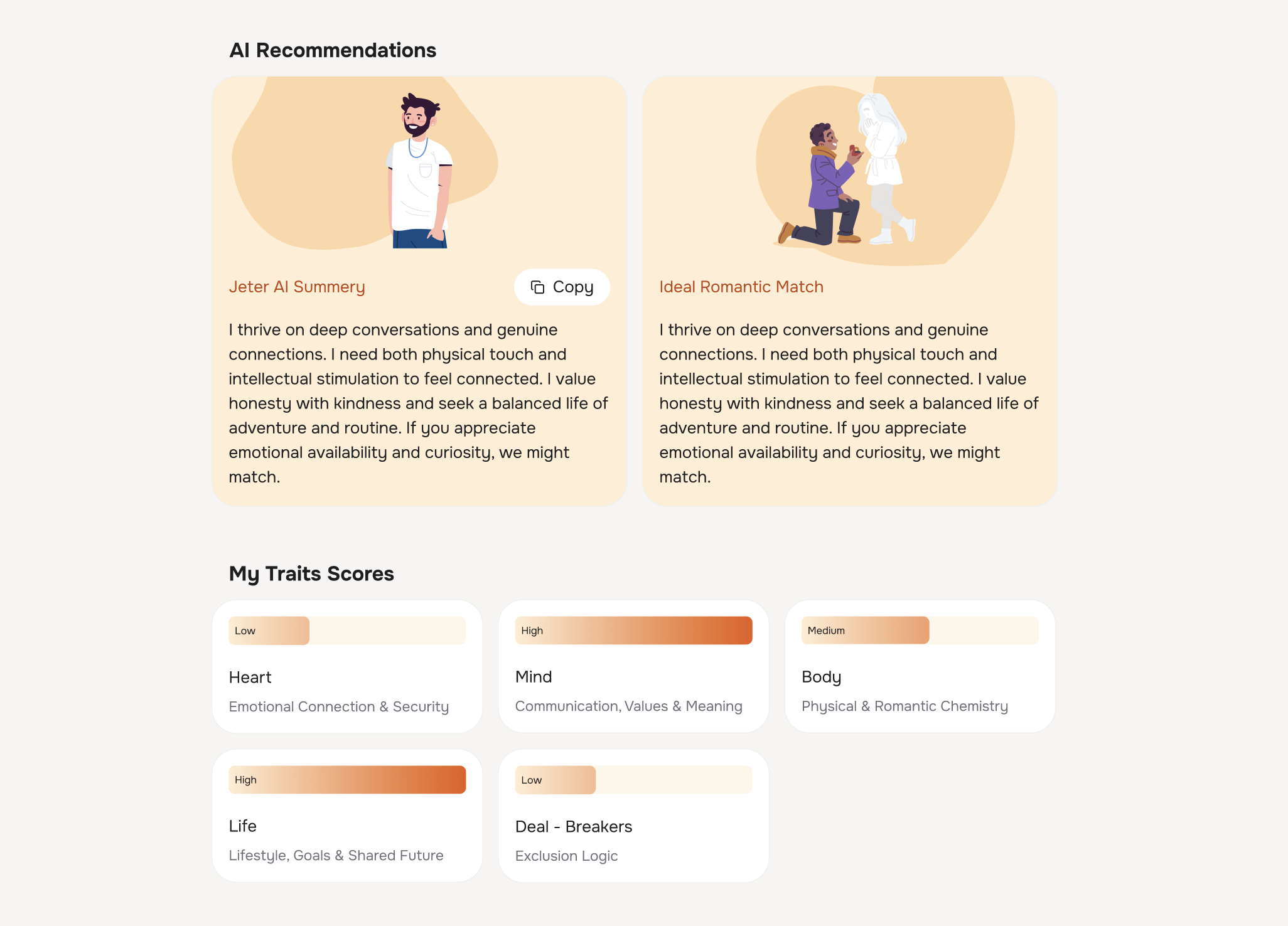
Intentional Dating: Why Compatibility Before the First Date Matters
Intentional Dating means dating with clarity about what you want, what you won’t tolerate, and how you evaluate potential partners beyond chemistry alone. It’s the opposite of “swipe and hope for the best.” Instead of just waiting for love to happen, intentional daters actively seek compatibility before investing emotionally—choosing to shape their love story rather than leave it to chance.
This approach has gained significant traction as dating app fatigue hits crisis levels. Pew Research Center’s 2023 survey of over 5,000 U.S. singles found that frustration with dating apps is widespread, particularly among those seeking serious relationships. The paradox of choice—too many options reducing satisfaction rather than increasing it—has been documented by Columbia Business School researchers, showing that choice overload can reduce relationship satisfaction by 30%.
Why early-stage compatibility checks prevent heartbreak:
The traditional dating model has a fundamental flaw: you meet first, you get attached, and then you discover dealbreakers. By that point, walking away feels harder. Sunk cost fallacy kicks in. You tell yourself the differences aren’t that important. Six months or two years later, the same differences become relationship-ending.
Early vetting changes this pattern:
|
Traditional Model |
Intentional Dating Model |
|---|---|
|
Match → Chat → Date → Discover incompatibilities → Break up |
Assess compatibility → Understand fit → Decide whether to meet → Date with clarity |
|
Emotional investment precedes information |
Information precedes emotional investment |
|
Discovery happens after attachment |
Discovery happens before attachment |
|
What Jeter’s pre-date test reveals: |
|
|
The assessment surfaces deeper layers long before “we’re already attached and now it’s harder to walk away”: |
-
Views on children and family planning
-
Marriage timeline expectations
-
Monogamy preferences
-
Financial attitudes
-
Career vs. family prioritization
-
Geographic flexibility
These aren’t sexy first-date topics. But they’re the things that determine whether two people can build a life together.
Using scores as conversation starters:
Compatibility reports aren’t verdicts—they’re prompts for conversation. If your report shows misalignment on commitment pace, that’s not a command to ghost. It’s an invitation to discuss: “I noticed we might differ on how quickly we like to define relationships. Where are you on that?”
This transforms the first date from nervous small talk to meaningful dialogue about what actually matters.
The shift from reactive to informed dating:
Jeter AI represents a larger cultural shift from “see what happens” dating to research-backed AI Dating where decisions are grounded in data and values. You’re not removing chemistry or spontaneity. You’re ensuring that chemistry has somewhere to go—toward a connection that actually has long-term potential.
Using Jeter AI’s Love Test Links Across Tinder, Bumble, Hinge, and More
Jeter is intentionally designed to sit on top of existing dating platforms rather than replace them. You don’t have to abandon your Tinder, Bumble, or Hinge accounts. You just make every match smarter with compatibility data.
Concrete example: Using Jeter on Tinder
-
Match with someone interesting
-
Chat for a day or two—establish basic rapport
-
Send your Jeter compatibility link with a message like: “Hey, I found this fun compatibility thing—want to take it together before we plan our date? Way more interesting than endless texting!”
-
Both complete the test
-
Review results and decide whether to meet
The playful framing matters. You’re not saying “I need to vet you.” You’re saying “Let’s learn something interesting about us.”
Platform-specific timing suggestions:
|
Platform |
When to Send Link |
Suggested Message |
|---|---|---|
|
Tinder |
After 5-10 messages |
“Want to see our compatibility score? More fun than small talk 😊” |
|
Bumble |
After she sends first few messages |
“I’ve been trying this compatibility test thing—curious what we’d get?” |
|
Hinge |
After commenting on 2-3 prompts |
“Your prompts are great—want to see what a deeper compatibility check says about us?” |
|
Facebook Dating |
After establishing basic connection |
“Before we plan something, want to try this compatibility thing I found?” |
|
Instagram DM |
After a few back-and-forth messages |
“Random idea—there’s this compatibility test that goes way deeper than our zodiac signs. Down?” |
|
Why this works: |
||
|
Most people are tired of the same texting patterns. “What do you do for work?” “Where are you from?” “What are your hobbies?” The Jeter link introduces novelty while serving a practical purpose. It says: “I’m intentional about my dating life, and I value compatibility.” |
Sharing multiple times:
Many Jeter users share their link with several people they’re talking to. It becomes a default step in their dating pipeline. This isn’t about mass testing—it’s about using the same clarity process with anyone who might become a real connection.
Create your shareable link at https://jeter.ai/.

Love Tests That Go Offline: Jeter’s QR-Powered Singles Events
Most singles events rely on randomness. You walk in, scan the room, and rely on first impressions and vibes. Maybe you talk to the person standing nearest to the bar. Maybe you avoid eye contact with everyone and leave early. The chance of meaningful connection depends entirely on luck.
Jeter upgrades that experience with QR-enabled compatibility data.
How QR-powered events work:
At Jeter-powered in-person events, attendees scan a QR code on entry. This either connects their existing Jeter assessment or prompts them to complete a quick version on the spot. The system then links them into the compatibility matching infrastructure.
The event experience:
Rather than random seat assignments or awkward room-scanning, Jeter events guide participants toward people with higher compatibility:
-
Mixers where you’re introduced to top-compatibility matches rather than just whoever is nearby
-
Speed dating where rotation prioritizes alignment rather than arbitrary seat numbers
-
Social environments where the guesswork is reduced
Where Jeter events happen:
Jeter hosts singles events across 15+ major cities:
|
Region |
Cities |
|---|---|
|
Northeast |
New York City, Philadelphia, New Jersey, Boston, Washington DC |
|
South |
Atlanta, Miami, Nashville |
|
Central |
Chicago, Austin, Denver |
|
West |
Los Angeles, San Diego, San Francisco, Seattle |
|
Canada |
Toronto, Vancouver |
|
Pricing structure: |
|
|
In-person events typically range from $35-$75 depending on venue and format. The compatibility assessment itself remains free—tokens or tickets cover the curated experience, not the test. |
Why this beats traditional singles events:
Traditional events yield roughly 10% follow-up date rates according to Eventbrite data. Most conversations go nowhere because you’re talking to random people with unknown compatibility. Jeter events start with alignment, leading to higher quality interactions and better outcomes.
Check upcoming events in your city at Jeter AI Singles Events.
Compatibility-Based Virtual Speed Dating: A Smarter Love Test in Real Time
Traditional speed dating is fundamentally random. You meet a series of people assigned by seat number or arrival order. Some conversations spark; most don’t. You hope one of your brief interactions happens to land on someone compatible.
Jeter’s virtual speed dating eliminates that randomness.
The patent-pending algorithm:
Before virtual events, participants complete the same Jeter compatibility test used for link sharing. The system then ranks participants by compatibility and schedules their video dates accordingly—beginning with highest potential matches first.
This means your best compatibility matches get your freshest energy, not the random person who happened to be in seat 3.
How virtual events work:
-
Register for a virtual speed dating event ($25-$45 depending on format)
-
Complete your Jeter compatibility assessment before the event
-
On event night, join the video platform
-
Participate in short video dates (typically 5-8 minutes each)
-
Your highest-compatibility matches are scheduled first
-
After the event, review any mutual interest and exchange contact information
A live love test environment:
Each date becomes a test of how compatibility insights show up in real conversation. You already know where alignment exists—now you see whether chemistry matches the data. Less time is spent on obvious mismatches because the algorithm front-loads your strongest potential connections.
Why virtual works:
Virtual events are accessible regardless of city. They’re lower pressure than in-person events. And they’re efficient—you can meet 8-12 compatibility-matched people in a single evening from your couch.
Real results:
Consider someone who tried a Jeter virtual event after months of dating app burnout. Their first video date showed 85% alignment on family values and communication style. By the fourth date, they were surprised to find someone who genuinely matched what they were looking for. That initial compatibility data gave them confidence to invest attention—and the connection developed from there.

How Jeter AI Differs From Other AI Love Calculators
The market is flooded with AI love calculators. LoveTestAI generates romantic stories based on names. Generic tools promise “AI-powered compatibility” but rely on zodiac scenarios and numerology. TikTok filters give you flashy percentages with zero methodology behind them.
Jeter operates in a completely different category.
Data sources:
|
Other AI Love Calculators |
Jeter AI |
|---|---|
|
Names, birthdates, zodiac signs |
Behavioral patterns, values, attachment styles |
|
Arbitrary inputs that feel magical |
Scenario-based responses scored against validated frameworks |
|
No predictive power |
Based on relationship science with documented outcomes |
|
Outputs: |
|
|
Other AI Love Calculators |
Jeter AI |
|
———————————- |
——————————— |
|
Single percentage scores |
Multi-domain alignment profiles |
|
Romantic blurbs and love stories |
Concrete guidance on next steps |
|
Entertainment-focused |
Decision-focused |
|
Goals: |
|
|
Other AI Love Calculators |
Jeter AI |
|
——————————- |
——————————————————————— |
|
Fun, curiosity, viral sharing |
Intentional Dating support |
|
No real-world application |
Informs whether to meet, what to discuss, how to pace |
|
Standalone quizzes |
Integrated ecosystem (tests, reports, events, virtual speed dating) |
|
The ecosystem advantage: |
|
|
Jeter isn’t just a quiz you take once and forget. It’s a platform that connects compatibility testing to real-world dating experiences. Your assessment informs your link sharing, your event matching, your virtual speed dating pairings, and your AI guidance conversations. Everything works together. |
Respectful positioning:
Fun love tests have their place. There’s nothing wrong with taking a name-based calculator for entertainment, exploring what your zodiac sign compatibility might mean, or playing with AI-generated love stories. But if you’re ready to move from playful curiosity to meaningful action—to actually improve your dating outcomes—Jeter offers something different.
Who Jeter’s Love Test Is Really For (And Who It Isn’t)
Jeter AI isn’t designed to serve everyone. By design, it serves singles who care about alignment over volume, quality over quantity, clarity over chaos.
Core users who benefit most:
-
Busy professionals who don’t have time for endless dead-end dates
-
Intentional daters who know what they want and aren’t willing to settle
-
People burned out on swipe culture who’ve grown tired of the same fruitless patterns
-
Those returning to dating after divorce or major life transitions who want more clarity this time around
-
Singles over 30 who are past the “let’s just see what happens” phase
Personality traits that thrive with Jeter:
|
Trait |
Why It Helps |
|---|---|
|
Planners |
Appreciate structured approach to dating decisions |
|
Self-aware individuals |
Can answer questions honestly and use results meaningfully |
|
Growth-oriented people |
See compatibility data as information, not destiny |
|
Deep conversation lovers |
Value substance over small talk |
|
Efficiency-minded |
Prefer filtering early over wasting time |
|
Who might not resonate: |
-
Users seeking purely casual encounters with no emotional investment
-
People who prefer complete spontaneity and resist any structured approach
-
Those who enjoy the chaos and unpredictability of modern dating
-
Anyone not ready to be honest about what they actually want
The cultural shift:
Research on choice overload shows that too many options reduce satisfaction. Dating apps offer infinite potential matches—which paradoxically makes choosing harder, not easier. Jeter addresses this by adding a filter: not just “who is available” but “who actually aligns with what I’m looking for.”
A simple litmus test:
If you’ve ever thought “I wish I knew this wasn’t going anywhere before the third date,” Jeter’s love test is intended for you.
How to Turn a Jeter Love Test Into Better Conversations
The compatibility report isn’t a pass/fail result. It’s a conversation starter and relational roadmap. The goal isn’t to judge someone based on a score—it’s to use the insights to have better, more meaningful conversations about what actually matters.
Share results and discuss them:
After both people see the report, use it as a jumping-off point:
-
“I noticed we’re both really aligned on family values—that’s exciting to hear.”
-
“Looks like we might differ on communication styles. I tend to be pretty direct—how do you usually handle disagreement?”
-
“The test flagged that we have different paces for commitment. Where are you on that spectrum?”
First-date questions based on compatibility insights:
Instead of generic small talk about hobbies and hometowns, use the report to guide deeper discussion:
|
If Report Shows |
Question to Ask |
|---|---|
|
Values alignment on family |
“What does your ideal family situation look like in 10 years?” |
|
Different conflict approaches |
“When we disagree about something, what works best for you?” |
|
Misaligned long-term goals |
“Where do you see yourself geographically in the next few years?” |
|
Strong lifestyle match |
“What does a perfect weekend look like to you?” |
|
Using AI guidance to script difficult topics: |
|
|
Some conversations are awkward to initiate. Kids. Finances. Monogamy. The AI guidance can help script these introductions in calm, respectful ways: |
-
“I’ve been thinking about what I want long-term, and I’d love to hear your thoughts on having kids someday.”
-
“Before we get further, I want to be upfront—I’m looking for something monogamous. Where are you on that?”
Deepening connection, not reducing romance:
Using data to inform conversations doesn’t eliminate chemistry or spontaneity. It ensures both people are choosing each other with eyes open. Mystery remains—but it’s mystery about personality quirks, shared experiences, and growing feelings, not about fundamental values that should have been discussed weeks ago.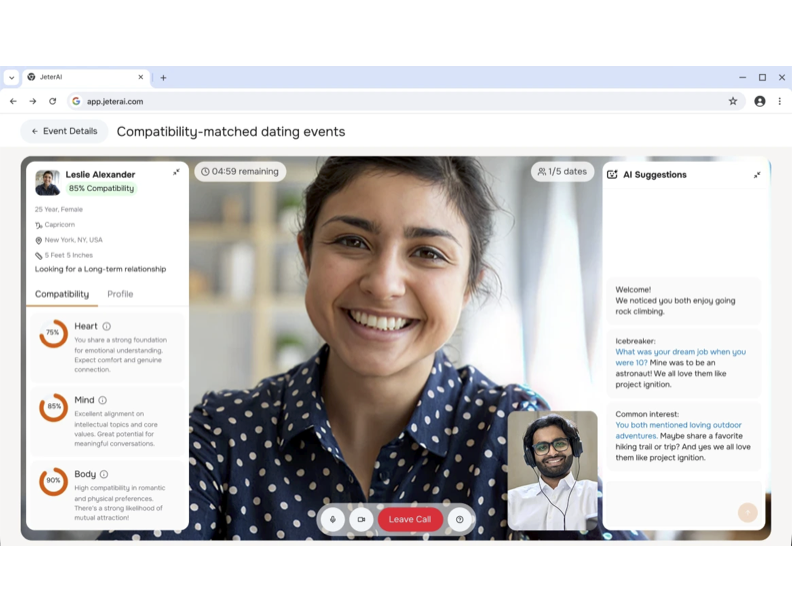
Pricing, Tokens, and Access: How Much Does This Love Test Actually Cost?
The Jeter compatibility assessment is free to take. You can sign up, complete the test, generate your compatibility link, and share it with matches without paying anything. This accessibility makes it easy to explore AI Dating and Intentional Dating without financial commitment.
The token model:
For full compatibility reports and advanced features, Jeter uses a token system instead of subscriptions:
|
Package |
Price |
What You Get |
|---|---|---|
|
3 tokens |
$10 |
3 full compatibility reports |
|
6 tokens |
$15 |
6 full compatibility reports |
|
12 tokens |
$25 |
12 full compatibility reports |
|
Tokens unlock detailed joint reports and access to the AI guidance features. |
||
|
Event pricing: |
|
Event Type |
Typical Price Range |
|---|---|
|
Virtual speed dating |
$25-$45 |
|
In-person singles events |
$35-$75 |
|
Pricing varies based on venue, format, and location. |
|
|
No recurring subscriptions: |
Unlike Hinge Preferred ($30/month), Bumble Premium ($40/month), or eHarmony subscriptions ($60+/month), Jeter has no recurring fees. You pay only when you choose to run deeper reports or attend events. This pay-per-use model keeps costs predictable and avoids the subscription trap that plagues other dating platforms.
For cost-conscious readers:
Even without purchasing tokens, you can:
-
Take the full compatibility assessment
-
Generate and share your link with matches
-
See basic compatibility insights
-
Access the AI guidance for initial questions
The core value—understanding compatibility before investing time—is available without spending a dollar.
How Jeter AI Fits Into the Modern Dating Landscape
The 2020s dating ecosystem includes swipe apps, curated matchmakers, singles events, and now AI Dating tools that layer intelligence onto all of the above. The market is projected to reach $9.6 billion globally according to Statista 2025 data, with AI integration growing 300% year-over-year.
Jeter’s positioning:
Jeter is pre-date compatibility infrastructure rather than a standalone app competing with Tinder, Bumble, or Hinge. A simple mapping:
|
Platform |
Function |
|---|---|
|
Tinder |
Discovery |
|
Hinge |
Conversation |
|
Jeter |
Decision intelligence |
|
Each layer serves a different purpose in the dating funnel. Jeter doesn’t ask you to delete your other apps—it makes them more effective. |
|
|
Built-in virality: |
Every time someone sends a Jeter compatibility link, they invite another potential user. This creates:
-
Natural growth loops without paid advertising
-
Conversation-based distribution
-
Embedded network effects
The product spreads through the same behavior it enables—sharing compatibility insights with people you’re interested in.
Why compatibility-first matters now:
Modern dating suffers from the paradox of choice. Tinder reports users swipe through 140 profiles daily on average. The abundance of options creates decision paralysis and reduces satisfaction. Research from Columbia Business School shows that too many choices actively hurt decision-making quality.
Jeter addresses this by adding a filter before the swipe decision becomes a date decision. It’s not about restricting options—it’s about clarifying which options actually deserve your time.
Learn more about the mission:
For readers curious about the team and technology behind Jeter, visit https://jeter.ai/about/.

Practical Tips: Getting the Most Out of Any Love Test
Jeter is built for serious compatibility insight, but let’s be honest—you’ll probably keep using playful love calculators too. That’s fine. Here’s how to use different tools appropriately.
Know the difference between entertainment and decision tools:
Treat name-based or zodiac love calculators as what they are: entertainment. They’re fun for a night when you’re curious about your crush, exploring potential with a friend, or just killing time. But don’t use them for major decisions like moving in together, having children, or ending a promising relationship because the world’s worst algorithm said you’re only 34% compatible.
Use rigorous tools when stakes are higher:
When you’re thinking about commitment, exclusivity, or integrating families and finances, that’s when science-backed assessments matter. The Jeter test was designed for exactly these moments—when you need clarity, not just a dopamine hit.
Answer honestly:
Any compatibility test is only as useful as the honesty of the answers. Research shows that idealized self-presentation skews results by roughly 25%. If you answer as the person you wish you were rather than the person you actually are, the compatibility report won’t reflect reality.
Revisit compatibility over time:
Consider retaking compatibility assessments after a few months of dating—not as a verdict, but as a check-in. See how real-life behavior aligns with initial test predictions. Note where you’ve grown together and where tension points remain.
Remember the limits:
Tests can point to patterns. They can surface potential friction. They can highlight alignment. But they cannot replace self-awareness, honest communication, therapy where appropriate, and mutual effort. Compatibility data is a starting point, not a destination.
Conclusion: From Love Test Games to a Smarter Way of Dating
We started with name-based love calculators that promised to predict your soulmate based on whether “John + Jane” added up to 85%. We’ve arrived at AI-powered compatibility platforms designed for real Intentional Dating decisions. That’s a significant evolution.
The core shift Jeter represents:
Traditional dating asks you to meet first and hope alignment appears later. Jeter flips that sequence. You understand compatibility, you evaluate fit, and then you decide whether meeting is worth your time and emotional energy.
The practical benefits:
-
Fewer dead-end dates that go nowhere
-
More aligned connections with genuine long-term potential
-
Better first-date conversations grounded in what actually matters
-
Clearer sense of whether to move forward or walk away early
Your next step:
Try the free compatibility test at Jeter AI with a current match or crush. It’s low-pressure, it’s free, and it gives you real insight before you invest another evening in someone who might not fit.
For those ready to meet people in real life:
Explore Jeter’s singles events and virtual speed dating at https://jeter.ai/singles-events/. These aren’t random mixers—they’re compatibility-matched experiences designed for people who value alignment over luck.
The larger shift:
We’re moving from guessing in love to choosing with clarity. From hoping chemistry equals compatibility to understanding that compatibility makes chemistry sustainable. From the anxiety of “will this work?” to the confidence of “I know what I’m walking into.”
That’s what a modern love test should offer. Not a number. Not a horoscope. But genuine insight that helps you choose the right person—before you’re already attached to the wrong one.
FAQ
Is Jeter’s love test just another fun quiz, or does it really work?
Jeter’s compatibility test is built on psychological research about values, communication patterns, attachment styles, and relationship behaviors—not random algorithms or name-matching tricks. While no tool can guarantee a perfect relationship (and anyone who promises that is lying), structured compatibility insights have been shown in decades of research to help people navigate conflict and align on long-term goals more effectively. The Gottman Institute’s methods, for example, predict relationship outcomes with over 90% accuracy. Jeter incorporates these validated frameworks into an accessible format designed for real-world dating decisions, not just entertainment.
Do both people need to sign up for Jeter to take the compatibility test?
Only one person needs a Jeter account to generate and share a compatibility link. The other person can join the experience through that shared link without creating their own account upfront. Once both complete the test, they gain access to a joint compatibility report. Either party can choose to create an account afterward if they want ongoing access to events, AI guidance, and additional features. This makes it easy to invite people from Tinder, Bumble, Hinge, OkCupid, Facebook Dating, or even someone you met
The Importance of Friendship in Lasting Compatibility
When it comes to building a relationship that stands the test of time, friendship is the secret ingredient that often gets overlooked. In the early stage of dating, it’s easy to get swept up in the excitement of a new connection, comparing compatibility scores from a love calculator or love tester and hoping you’ve found your perfect match. But while a high score can be a fun way to break the ice and spark conversation, the real magic happens when two people take the time to develop a genuine friendship.
A strong friendship between partners means you truly understand each other’s personalities, quirks, and life goals. This foundation makes it easier to navigate the ups and downs of real life together, turning everyday moments into opportunities for deeper connection. When you prioritize friendship, you’re not just looking for someone who matches your interests or gets a high compatibility score—you’re looking for a partner who feels like your best friend, someone you can laugh with, confide in, and rely on through every season of life.
True love isn’t just about chemistry or a perfect match on paper. It’s about building a relationship where both people feel seen, accepted, and supported. By focusing on friendship first, you give your relationship the best chance to grow into something lasting and meaningful. So, while it’s fun to check your compatibility score or play with a love tester, remember that the strongest connections are built on trust, communication, and the kind of friendship that makes every day together feel like a new adventure.
Overcoming Dating Challenges with Jeter AI
Navigating the world of dating can be overwhelming, especially when you’re faced with endless profiles, mixed signals, and the ever-present doubt about whether you’ll find someone truly compatible. That’s where Jeter AI steps in, transforming the dating experience from a guessing game into a journey of real-life connection and clarity.
Jeter AI uses advanced technology to analyze key compatibility factors—like your zodiac sign, personality traits, and interests—to generate a comprehensive compatibility score. This score isn’t just a number; it’s a roadmap that helps you understand how well you and a potential partner might connect in real life. Whether you’re new to dating apps or a seasoned pro, Jeter AI makes it easy to meet people who genuinely align with your values and lifestyle.
The app goes beyond just matching you with compatible partners. It offers personalized coaching, practical dating tips, and conversation starters designed to boost your confidence and help you navigate the early stages of a relationship. With Jeter AI, you can approach dating in a fun and intentional way, knowing that every connection is backed by real compatibility data—not just a lucky guess.
If you’ve ever felt uncertain or doubted whether you’re making the right choices in your dating life, Jeter AI is here to help. Its user-friendly interface and science-backed assessments take the stress out of meeting new people, making it easier to focus on building meaningful relationships. In a world where finding true love can feel like searching for a needle in a haystack, Jeter AI gives you the tools to connect, communicate, and create a love story that actually makes sense for your life.


